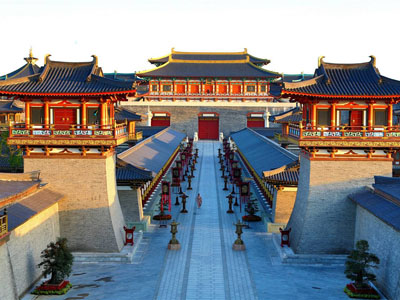
 The Imperial Tombs of the Ming and Qing Dynasties are among the most remarkable examples of ancient Chinese imperial architecture and burial traditions. Distributed across Beijing and several provinces, including Hebei, Liaoning, Anhui, Jiangsu, and Hubei, these magnificent mausoleum complexes were built for emperors, empresses, and members of the imperial families between the Ming (1368–1644) and Qing (1644–1911) dynasties.
As some of the most important national construction projects of their time, the imperial tombs were often personally supervised by emperors and designed by the finest architects and craftsmen. Many of these historical sites remain remarkably well preserved today.
The Ming and Qing Imperial Tombs were inscribed as a UNESCO World Heritage Site for their outstanding cultural and architectural value.
Cultural Heritage of the Imperial Tombs
The imperial tombs represent the highest achievements of architectural design and planning during the Ming and Qing periods. They provide valuable insight into the beliefs, philosophy, social systems, and views on life and death in traditional Chinese feudal society.
The design of the tombs reflects important Chinese concepts, especially the principles of Feng Shui (geomancy), which emphasized harmony between humans and nature. Mountains, rivers, and surrounding landscapes were carefully considered when selecting the locations of imperial burial sites.
The tombs were also important ceremonial centers. During the Ming and Qing dynasties, large-scale sacrificial ceremonies were held regularly at the imperial mausoleums. Some ceremonies were conducted by government officials, while others were personally attended by emperors. Temporary palaces were built near the tombs to accommodate royal visitors during these occasions.
Architecture of the Ming Tombs
The 13 Ming Tombs in Beijing are located in a valley at the foot of the Tianshou Mountains, about 50 kilometers northwest of central Beijing. Although each tomb has its own characteristics, they share a similar architectural style.
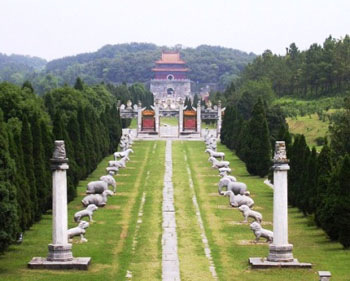 Surrounded by ancient pine and cypress forests, the tomb complexes were usually arranged along a central axis and featured:
* Red walls and yellow glazed roof tiles symbolizing imperial authority
* Grand gates and ceremonial buildings
* Stone bridges and memorial structures
* Underground burial palaces
* Sacred pathways lined with stone statues
The entrance to the tomb area features a magnificent stone memorial archway, one of the largest ancient stone gateways in China. It is approximately 14 meters high and 29 meters wide.
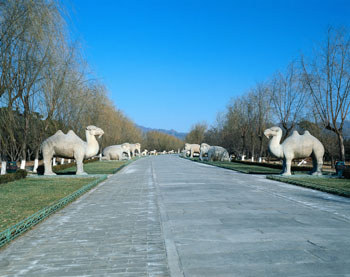
Beyond the entrance, visitors follow the famous Sacred Way (Shen Dao), a ceremonial road decorated with 18 pairs of stone statues, including 24 animal figures and 12 human figures. These stone guardians symbolically protected the emperors on their journey into the afterlife.
Among the 13 Ming Tombs, the most famous and impressive are:
* Changling Tomb – the largest and best-preserved Ming imperial tomb, built for Emperor Yongle.
* Dingling Tomb – famous for its underground palace, which has been opened to visitors.
* Yongling Tomb – one of the grandest tomb complexes of the Ming Dynasty.
The Ming and Qing Imperial Tombs are outstanding examples of traditional Chinese architecture and Feng Shui planning.
Imperial Burial and Memorial Ceremonies
The funeral ceremonies of Ming and Qing emperors were extremely solemn and followed strict rituals.
After an emperor’s death, his coffin was placed in the palace while preparations for the funeral were completed. On the day of departure, the crown prince, imperial family members, officials, and other mourners gathered for a farewell ceremony.
The coffin was then transported from the Forbidden City to the imperial tombs, accompanied by a grand procession. Along the route, memorial altars were prepared where nobles, officials, religious figures, and local representatives performed rituals and offered sacrifices.
When the coffin arrived at the mausoleum, it was not immediately placed underground. The burial had to wait for an astrologically chosen auspicious time according to traditional beliefs. Only after all burial objects were placed inside the Underground Palace and the stone gate was sealed was the emperor’s funeral considered complete.
Visiting the Ming Tombs Today
Today, the Ming and Qing Imperial Tombs offer visitors a fascinating journey into China’s imperial past. The combination of grand architecture, peaceful mountain landscapes, ancient rituals, and traditional philosophy makes these tombs an important destination for travelers interested in Chinese history and culture.
Located near Beijing, the Ming Tombs are often visited together with other famous attractions such as the Great Wall at Badaling, making them an ideal addition to a Beijing cultural tour.