




search for a Trip
Wutaishan Mountain
Mount Wutai, also known as Wutai Mountain, is one of the Four Sacred Buddhist Mountains of China and has one of the longest and most distinguished Buddhist histories among them. It is also unique for its long tradition of both Chinese Buddhism and Tibetan Buddhist practices.
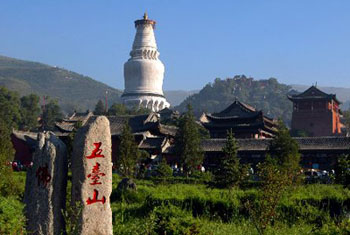 For centuries, Mount Wutai has been regarded as one of China’s most important Buddhist pilgrimage destinations. According to Buddhist tradition, the mountain is closely associated with Manjusri, the Bodhisattva of Wisdom, who is believed to have taught and manifested here. Its religious importance attracted emperors, monks and pilgrims from many dynasties, leaving behind a remarkable collection of temples, sculptures, paintings and other Buddhist cultural relics.
Located in Wutai County, Shanxi Province, approximately 240 kilometers from Taiyuan, Mount Wutai consists of five major peaks arranged around the Taihuai valley. These five “terraces” give the mountain its name, Wutai, meaning “Five Terraces.” Because of its cool and pleasant climate, particularly in summer, it is also known as Qingliang Mountain, or the “Cool and Pleasant Mountain.”
Temple construction on Mount Wutai began during the Eastern Han Dynasty, traditionally dated to the reign of Emperor Mingdi. Construction and restoration continued throughout successive dynasties, gradually creating an extensive complex of Buddhist architecture.
At its historical peak, Mount Wutai was home to hundreds of temples and thousands of monks. Today, dozens of historic temples remain, preserving an extraordinary collection of Buddhist sculptures, murals, inscriptions and other cultural treasures.
Scenery of Mount Wutai
The natural scenery of Mount Wutai is closely associated with its five principal peaks: Wanghai Peak in the east, Guayue Peak in the west, Jinxiu Peak in the south, Yedou Peak in the north and Cuiyan Peak in the center. Each peak has its own distinctive landscape and cultural significance.
Wanghai Peak – Peak Overlooking the Sea
Wanghai Peak is located approximately 1 kilometer east of Taihuai Town and reaches an elevation of about 2,795 meters.
The peak is particularly famous for its spectacular sunrise. In the early morning, clouds and mist often fill the valleys below, creating the impression of a vast sea of clouds. As the sun rises above the horizon, golden light spreads across the mountains, creating one of Mount Wutai’s most memorable natural landscapes.
Guayue Peak – Hanging Moon Peak
Guayue Peak lies approximately 13 kilometers west of Taihuai Town and reaches an elevation of about 2,773 meters.
The peak is especially atmospheric in the evening. The sight of the moon appearing above the mountain forests and pine trees creates a peaceful and poetic landscape, which is reflected in its name, meaning “Hanging Moon Peak.”
Jinxiu Peak – Splendor Peak
Jinxiu Peak is approximately 12 kilometers south of Taihuai Town and has an elevation of about 2,485 meters.
The peak is known for its colorful alpine vegetation and seasonal flowers. From spring through summer, wildflowers cover parts of the mountain slopes, creating a beautiful contrast with the surrounding green landscape.
Yedou Peak – Peak of Flourishing Leaves
Yedou Peak is located about 5 kilometers north of Taihuai Town and reaches approximately 3,058 meters above sea level. It is the highest of the five main peaks of Mount Wutai.
A natural pool can be found on the summit plateau. From the northern side of the peak, visitors can enjoy expansive views toward the surrounding mountains, including Mount Hengshan in the distance.
Cuiyan Peak – Peak of Green Rocks
Cuiyan Peak is the central peak among the five terraces. Its name refers to the green appearance of its rocks, which are largely covered with moss rather than naturally green stone.
The large moss-covered rocks create distinctive shapes, and some are traditionally described as resembling twisting or moving dragons. This unusual geological and natural scenery adds to the character of the central terrace.
 Buddhist Temples of Mount Wutai
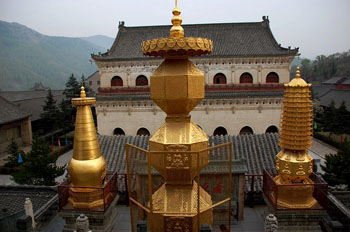
Mount Wutai has attracted pilgrims and visitors for centuries and is home to numerous historic Buddhist temples. Among the most famous are Xiantong Temple, Tayuan Temple, Manjusri Temple, Shuxiang Temple and Luohou Temple.
Xiantong Temple
Xiantong Temple is one of the oldest and most important temples on Mount Wutai. According to tradition, its history dates back to 68 AD during the Eastern Han Dynasty, although the temple complex was expanded and rebuilt by successive dynasties.
The temple occupies a large area and contains numerous halls and courtyards. It is also closely associated with the Buddhist community of Mount Wutai.
Among its notable features are statues dedicated to Manjusri Bodhisattva and a large bronze bell. The temple’s traditional architecture and long history make it one of the essential cultural attractions for visitors exploring Mount Wutai.
Tayuan Temple
Tayuan Temple is one of the most recognizable landmarks of Mount Wutai and is famous for its distinctive white Tibetan-style stupa, known as the Dabai Pagoda, or Great White Pagoda.
Standing prominently among the temples of Taihuai, the pagoda is one of the symbols of Mount Wutai. The temple complex also contains other important structures associated with Buddhist culture, including the Wenshu Hair Pagoda and the Dacangjing Pavilion, traditionally associated with the preservation of Buddhist scriptures.
Manjusri Temple
Manjusri Temple, also known as Bodhisattva Summit or Zhenrongyuan, is one of the most important temples associated with Manjusri Bodhisattva.
The temple is traditionally believed to have been established during the Northern Wei Dynasty. During the Ming Dynasty, Tibetan Buddhist monks began to establish a stronger presence on Mount Wutai, and the temple became an important center of Tibetan Buddhist practice.
Emperors Kangxi and Qianlong of the Qing Dynasty both visited Mount Wutai and left inscriptions associated with their pilgrimages.
Shuxiang Temple
Shuxiang Temple is located southwest of Tayuan Temple and is famous for its large statue of Manjusri Bodhisattva.
The temple complex contains numerous halls and courtyards, with the Manjusri Pavilion serving as one of its major structures. A spring known as Prajna Spring is also associated with the temple. The name “Prajna” refers to wisdom in Buddhist philosophy and is closely connected with the worship of Manjusri.
Luohou Temple
Luohou Temple is located east of Xiantong Temple and has a long history of Tibetan Buddhist traditions.
One of its most unusual features is a mechanical wooden lotus. When activated, the wooden petals open and close to reveal Buddhist figures inside. This combination of religious symbolism, traditional craftsmanship and mechanical ingenuity makes the feature particularly interesting to visitors.
Dailuo Peak
For visitors who want to experience the worship of the five forms of Manjusri but have limited time, Dailuo Peak is an excellent choice.
Located near the central temple area of Taihuai Town, Dailuo Peak is known for the Wufang Manjusri Palace, which houses five statues representing the five forms of Manjusri associated with the five terraces of Mount Wutai.
Visitors can climb more than 1,000 steps to reach the summit, while a cable car is also available for those who prefer a more convenient way to ascend.
Other Historic Temples
In addition to the major temples mentioned above, Mount Wutai contains many other historic Buddhist sites. These include Jinge Temple, Nanchan Temple, Shifangtang, Wangfo Temple and other temples and monasteries scattered throughout the mountain region.
Together, these historic buildings, religious traditions and natural landscapes make Mount Wutai an important destination for Buddhist pilgrims, cultural travelers, history enthusiasts and visitors interested in traditional Chinese architecture.
Mount Wutai offers a unique combination of sacred Buddhist heritage, spectacular mountain scenery and centuries of cultural history. A visit here provides not only an opportunity to explore ancient temples and religious art but also a chance to experience one of China’s most distinctive spiritual landscapes.
Related Tours:
China Attractions Guide
- Anhui Attractions
- Beijing Attractions
- Chongqing Attractions
- Fujian Attractions
- Gansu Attractions
- Guangdong Attractions
- Guangxi Attractions
- Guizhou Attractions
- Hainan Attractions
- Henan Attractions
- Hongkong Attractions
- Hubei Attractions
- Hunan Attractions
- Heilongjiang Attractions
- Inner Mongolia Attractions
- Jiangsu Attractions
- Jilin Attractions
- Jiangxi Attractions
- Liaoning Attractions
- Manchuria Attractions

