




search for a Trip
Wudangshan Mountain
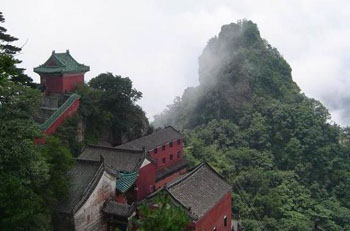 Located in northwestern Hubei Province, Mount Wudang, also known as Wudangshan, is one of China’s most famous Taoist sacred mountains. Covering an area of more than 30 square kilometers, the mountain is renowned for its magnificent scenery, ancient Taoist architecture and the legendary origins of Wudang martial arts.
With a history of over a thousand years, Mount Wudang has long been regarded as an important center of Taoism. As early as the Eastern Han Dynasty (25–220 AD), the mountain attracted attention from imperial courts because of its spiritual significance and natural beauty.
During the Tang Dynasty (618–907), the first important Taoist sanctuary, the Five Dragon Temple, was built on the mountain. Mount Wudang reached its peak of religious importance during the Ming Dynasty. In the 15th century, Ming emperors supported large-scale construction projects, sending hundreds of thousands of soldiers and craftsmen to build temples, palaces, pavilions and other religious structures throughout the mountain.
Today, Mount Wudang is recognized as one of China’s most important cultural and natural attractions, preserving a remarkable combination of Taoist heritage, ancient architecture and mountain landscapes.
Natural Beauty and Biodiversity
As a national scenic area, Mount Wudang features dramatic peaks, peaceful valleys, forests and rich plant life. The mountain’s diverse ecosystem has supported a wide variety of plants, including many species with traditional medicinal value.
Li Shizhen, the famous Ming Dynasty pharmacologist and author of Compendium of Materia Medica, recorded more than 400 medicinal plants from the Wudang region, highlighting the mountain’s importance in traditional Chinese medicine.
The combination of forests, clean air and unique landscapes makes Mount Wudang an ideal destination for travelers seeking both natural beauty and cultural experiences.
 Birthplace of Wudang Martial Arts
Besides its Taoist heritage, Mount Wudang is also famous worldwide as the birthplace of Wudang martial arts (Wushu).
According to tradition, Wudang martial arts were developed by Zhang Sanfeng, a legendary Taoist master from the Ming Dynasty. Combining martial techniques with Taoist philosophy, Wudang Wushu emphasizes balance, inner strength and harmony between body and mind.
Several Wushu schools and training centers can be found at the foot of the mountain, where visitors can experience traditional martial arts performances and learn about this important part of Chinese culture.
Famous Scenic Spots
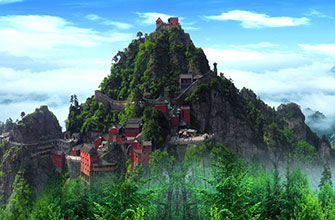
The highest peak of Mount Wudang is Tianzhu Peak, which rises 1,612 meters above sea level. Its name means “Pillar Supporting the Sky” or “Heavenly Pillar Peak,” reflecting its impressive appearance and symbolic importance.
Among the many historic sites on Mount Wudang, the most famous include:
Golden Hall
Located on Tianzhu Peak, the Golden Hall is one of the most iconic landmarks of Mount Wudang. Built during the Ming Dynasty, this bronze-gilded structure is a masterpiece of ancient Chinese architecture and craftsmanship.
Nanyan Temple
Nanyan Temple is famous for its dramatic location on a cliffside overlooking the surrounding mountains. The temple combines natural scenery with exquisite Taoist architecture and is considered one of the most beautiful sites on Mount Wudang.
Purple Cloud Temple
Purple Cloud Temple is one of the best-preserved Taoist temple complexes on the mountain. Built during the Ming Dynasty, it contains important Taoist halls, statues and cultural relics.
Taoist Architectural Heritage
Mount Wudang is home to the largest existing complex of Taoist buildings in China. Its temples, palaces and pavilions represent outstanding examples of ancient Chinese architectural design.
Many of these historic structures contain valuable Taoist artworks, sculptures and religious relics, reflecting the close relationship between Chinese architecture, philosophy and spirituality.
With its sacred Taoist traditions, spectacular mountain scenery, ancient architecture and legendary martial arts culture, Mount Wudang remains one of China’s most fascinating destinations for cultural and spiritual travel.
Related Tours:
China Attractions Guide
- Anhui Attractions
- Beijing Attractions
- Chongqing Attractions
- Fujian Attractions
- Gansu Attractions
- Guangdong Attractions
- Guangxi Attractions
- Guizhou Attractions
- Hainan Attractions
- Henan Attractions
- Hongkong Attractions
- Hubei Attractions
- Hunan Attractions
- Heilongjiang Attractions
- Inner Mongolia Attractions
- Jiangsu Attractions
- Jilin Attractions
- Jiangxi Attractions
- Liaoning Attractions
- Manchuria Attractions

