Tibetan Culture is a large concept which includes many sides as custom, food, festival, etc. Here we just copied a few of them for your information.
Tibetan Custom
1. Presenting Hada
Present hada is a common practice among the Tibetan people to express their best wishes on many occasions, such as wedding ceremonies, festivals, visiting the elders and the betters, and entertaining guests. The white hada, a long narrow scarf made of silk, embodies purity and good fortune.
2. Proposing a Toast and Tea
Proposing a Toast and Tea When you come to a Tibetan family, the host will propose a toast, usually barley wine. You should sip three times and then drink up. To entertain guests with tea is a daily etiquette. The guest has not to drink until the host presents the tea to you.
3. Greetings
Greetings Don't forget to add "la" after saying hello to the Tibetan people to show respect . Make Way to others. Try not to make any sounds while eating and drinking.
4. Sky Burials
Sky burial is a common form in Tibet. There are many prohibitions. Strangers are not allowed to attend the ceremony. Visitors should respect this custom and keep away from such occasions.
5. Tibetan Buddhism
Also known as the Lamaism, the Tibetan Buddhism was introduced to Tibet from the mainland and India in the seventh century. The Tibetan Buddhism consists of four major sects, the Ge-lug-pa(Yellow) Sect, the Nying-ma-pa(Red)Sec, the Saturday-kya-pa(Variegated) Sect, and the Ka-gyu-pa(White) Sect.
6. Pilgrimage
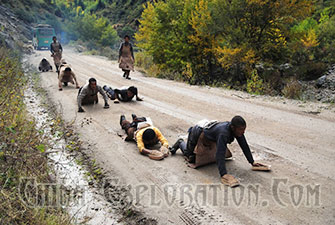
The immediate motivations of pilgrimage are many, but for the ordinary Tibetan it amounts to a means of accumulating merit or good luck. The lay practitioner might go on pilgrimage in the hope of winning a better rebirth, cure an illness, end a spate of bad luck or simply because of a vow to take a pilgrimage if a bodhisattva granted a wish.
In Tibet there are countless sacred destinations, ranging from lakes and mountains to monasteries and caves that once served as meditation retreats for important yogin. Specific pilgrimages are often proscribed for specific ills; certain mountains for example expiate certain sins. A circumambulation of Mt. Kailash offers the possibility of liberation within three lifetimes, while a circuit of Lake Manasarovar can result in spontaneous Buddha hood.
7. Food in Tibet
Food in Tibet differs in pastoral areas and agricultural areas. The staple food includes roasted highland barley flour, wheat flour, meat, or red food, and milk, or white food. The principle in summer is the white food, while that in winter is the red food. Local flavors in the pastoral areas are mutton sausage, and dried beef.
The flavor of the Tibetan food is fresh, light, and tender. Salt, onion, and garlic are the main ingredients.
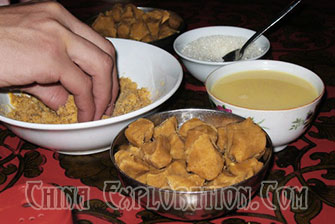
Traditional Tibetan food consists mainly of barley, meat and dairy products. Vegetables are scarce in the high altitude. Tsampa is the staple food of Tibetan people, which is consumed daily. Tsampa is actually barley flour made from parched barley, un-husked and ground into fine flour. Mix the flour with salted butter tea in a bowl, rotate the bowl with the left hand and mix the food with the fingers of your right hand, rolling it into small lumps, and squeezing it into your mouth with your fingers. Other ingredients may also be added to add flavor.
Big sides of beef and mutton boiled with salt, ginger and spices are also popular food among Tibetans. They take the meat and cut them with their knives. The guests will be treated with breasts and spareribs. If you are treated with a tail of white sheep, it means that you are deemed as their guest of honor.
Tibetans like drinking tea. Besides salted butter tea, sweet milk tea is another popular beverage. Hot boiling black tea filtered is decanted into a churn, and then fresh milk.
Tibetan Festivals
Tibetan people have their unique culture. A Tibet tour will be one of your most unforgettable experiences in your life. Here we have listed the major traditional Tibetan festivals below and you can learn about the interesting things about Tibetan people.
1. Tibetan New Year
Date: December 28-29 (Tibetan Calendar)
Tibetan New Year is the most significant festival in Tibet. Different areas have different ways to celebrate it, with Lhasa the most representative.
In ancient times when the peach tree was in blossom, it was considered as the starting of a new year. Since the systematization of the Tibetan calendar in 1027 A.D., The first day of the first month became fixed as the new year.
Before the Tibetan New Year, each household makes "qiema" (a wooden measure for grain), expressing the wish of good harvest and auspiciousness in the coming year. They will also make "kasai" (fried twisted dough sticks) in various forms, which looks golden and tastes crispy, and "luoguo" (a kind of food made of butter in the shape of sheephead), signifying thriving domestic animals and abundant life. In addition, they offer dried or fresh fruits, butter and brick tea to Buddhas.
On December 28-29 according to Tibetan calendar, all the families clean their houses and draw "eight auspicious paintings" on the center of the kitchen wall. Before the dinner of December 29, they will spray lime in front of their houses to form designs of auspiciousness. On New Year's Eve, all family members will get together to have a big dinner. They will eat "gutu," made of beef and mutton, turnip and flour lump. What is interesting is that some stones, coins, salt, pepper, charcoal and wool are wrapped in the flour lump. When people eat, they have to be very careful to see what is in their next mouthful of food. The laughers fill the room at that time. After the dinner, they hold a ceremony to drive away ghosts.
On the first day of the New Year, the Tibetans get up early. Some even stay up through the whole night. But they could not go out so early. The first program for them will be "scrambling for water." According to customs, the one who gets the first barrel of water at day-break is the luckiest one of the year. Only when the morning star rises and someone shouts "Lajieluo (God wins! )" can Tibetans rush out. Another important activity in the morning is to go to the Jokhang Monastery to offer sacrifices to Sakyamuni, founder of Buddhism. On this day, people must wear the most beautiful clothes and the most precious jewels.
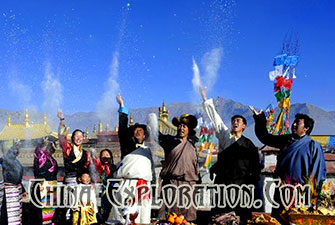
People don't visit each other on the first day of the year. Starting from the next day, they begin visiting relatives and friends, which will last three to five days. On the 3rd day of the 1 st Tibetan month, they offer sacrifices to the "God of Roof." All of them climb to the roof of their house and hang the new sutra streamer. Then they burn cypress branches and throw zamba into the air. Lhasa people go in groups to the Baoping (Treasured Bottle) Mountain in the east and Chakpori (King of Medicine) Mountain in the west to stick in scripture pole and hang sutra streamer to worship the gods of mountain and water.
From the 4th day on, Tibetans start their largest religious festival - Grand Summons Ceremony, which will end on the 15th day of the 1 st Tibetan month. On the 5th day, farmers in Lhasa suburbs hold grand ceremonies to start ploughing.
According to traditions, the celebration activities on the Tibetan New Year will last 15 days.
2. Butter Lantern Festival
Date: January 15 (Tibetan Calendar)
January 15 of Tibetan calendar sees the last high tide of celebrations of the Tibetan New Year. On this day, people go to temples to burn incense to worship Buddhas. As darkness falls, they will put up many stands to display the butter lanterns they made themselves.
The lanterns are in forms of auspicious symbols such as gods, figures, flowers and trees, birds and beasts, and can be burnt. The stands go as high as three-story buildings, even the lower ones are two-story high. The lanterns are either grand or small. The lights make the whole street bright as in the day. People sing and dance while enjoying the lanterns. The Butter Lantern Festival is also called Lantern Festival. The preparation for this festival takes a good part of four months.
3. Sagar Dawa Festival
Date: In April, around 15th (Tibetan Calendar)
Sagar Dawa Festival is an influential religious festival in Tibet.
Sagar Dawa represents April in Tibetan calendar. Buddhism believes that Sakyamuni was born, became Buddha and died in April, so the Sagar Dawa Festival mainly focuses on worshiping Buddha in the inner, middle and outer parts of Lhasa. All the activities last through the whole month. The grandest one is on April 15 when the Buddhist followers walk around the outer part of Lhasa. They recite scriptures while walking on the 8,000-metre-long outer ring of Lhasa, forming a grand troop. Passing by mulberry stoves or fires, they add cypress branches, mugwort, Chinese photinia or zamba. At intersections of roads, they will put off their hats to bow towards the direction of the Potala Palace.
In the afternoon, they all get together at Zongjolukang (Dragon King's Pool) at the back of the Red Hill, where they boat, sing, dance and entertain themselves. It is said that good deeds in the month of this festival deserve 300 fold in return and this leads many people to donate large sums to the religious orders, monasteries and to the beggars that gather at this time of year.
The festival reaches its climax on April 15, which is considered the birthday and the day that Sakyamuni entered nirvana.
4. Shoton Festival of Lhasa
Date: Starting on June 30th and last for five days (Tibetan Calendar)
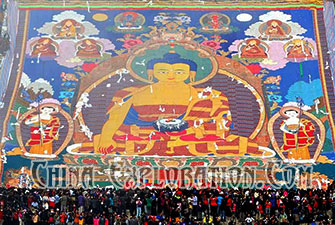
"Shoton" in Tibetan means yoghurt banquet. As Tibetan operas are performed and Buddha paintings are exhibited at this time, it is also called "Tibetan Opera Festival" or "Buddha Exhibition Festival." The traditional way of starting the Shoton Festival is to show Buddha paintings. The main contents include Tibetan operas and gala parties, as well as wonderful yak racing and horsemanship display. The Shoton Festival starts on the 30th day of the 6th month according to Tibetan calendar (usu. later half of August) and lasts five days.
It was said that the festival can be traced back to the 11th century when Master Atisha (a monk from Bengal) was dwelling and studying in Nethang monastery in summer of that year, he set up rules for his students to follow, one of the set rules is that lamas should not leave monastery out to enjoy funs in case of protecting little creatures of the nature from being trampled to death.
In 11th century, Buddhism was getting recovery from the heavy hit of King Darmo (the Tibetan king in 9th century who issued harsh laws to prohibit the spreading and any religious activities in Tibet highland in favor of his party), people between mid 9th century and mid 11th century had suffered a lot from the continuous and disastrous wars and rebellions and all prayed to God to wish having peaceful life, in history when Buddhism was in power, the life of people would be better and the suffering of people is lighter, and Buddhism rituals advocate people to love little creatures, to respect the existence of lives and call on people to love each other and forget the hatred, revenge.
In Atisha's time, it is time to sow seeds of live and spreading Buddhism in this suffering highland, and the cause Atisha is dedicating himself to is meeting the spiritual needs of common people, so he got great respect and it was he who begin the refusion of Buddhism in this snowland 200 years after Darmo rooted Buddhism out, during that period in which Atisha and his students stayed inside the monastery, the locals around and Buddhism followers would offer then their best family-made Yoghurt, fruits and other seasoning food as their sacrifice to their spiritual master and a way to show their respect.
In 17th century when Gelupa defeated Kargyuelpa's power and began its rule over Tibet , the Fifth Dalai Lama ordered the operas to be performed in Drepung Monastery, Potala Palace and Norbulinka; during the celebration, Yoghurt was served, local style operas and songs were performed, it was a sea of songs and dances in these area. with time going, it gradually became one of the most grandest, important festival in Tibet prior to Tibet New year.
The prelude of the Shoton Festival is the Buddha exhibition in Drepung Monastery, which is held at the foot of the Gebeiwoze Mountain. The tranquil valley becomes excited. With the sound of sutra bugle reverberating through the valley, about 100 lamas will carry the large-scale tangka portraying Qamba Buddha (or Maitreya) out of the Coqen Hall of the Drepung Monastery and step toward the west of the monastery where a special platform is set up for the Buddha picture exhibition. At this moment, the mulberry smoke arises from all directions, bugles resound and scripture reciting goes on.
The large tangka then will be slowly opened up. People rush up to offer white hada. Countless hada fly in front of the Buddha picture, forming a great scene. In no more than two hours, the tangka will be rolled up again and carried back. People will not see it until the next year. Then people go to the courtyard of Gandain Phodrang to watch Tibetan Opera. In the afternoon, the activities center moves to Norbulingka. In the following week, the major activity is to watch the Tibetan Opera. During the Shoton Festival, the Tibetans bring along the old and the young and call on relatives and friends to Lingka gardens. The Norbulingka and other parks of Lhasa are dotted with colorful tents.
Nowadays, the Shoton Festival has become a comprehensive celebration activity with the most influences in Tibet. It is also a grand meeting for commodity exchanges.
5. Bathing Festival
Date: the first ten days of July (Tibetan Calendar)
The Bathing Festival usually falls on the first ten days of July according to Tibetan calendar. Lasting a week, it is also known as the Bathing Week. In Tibetan it is called "Gamariji," meaning Qishan star, or Venus. As the star rises to the sky, the mass bathing starts. As the star sets, the bathing ends. It is believed when the sacred planet Venus appears in the sky, the water in the river becomes purest and cure diseases.
According to Tibetan Buddhism, the water in Tibet at this time has eight advantages: sweet, cool, soft, light, clear, clean, unharmful to throat, nor to belly. Judged from the natural environment and climate of Tibet, the river water has a relatively high temperature and is suitable for bathing. During the seven days, tens of thousands of Tibetan men and women go to river or lake to have baths. The tents, big or small, dot the beach and Lingka into a colorful world.
6. Ongkor Festival (Bumper Harvest Festival)
Date: in August (Tibetan Calendar)
The Ongkor Festival is an old festival in farming areas of Tibet held in each August according to Tibetan calendar when all crops are waiting for harvest.
"Ongkor" in Tibetan means "surrounding the farmland." Major activities include horse racing, shooting, singing and dancing, Tibetan Opera, stone holding and wrestling. The "Ongkor" not only shows people's wish for a good harvest, but also a good time for them to rest. Since crops ripen in different times, the festival is held accordingly.
The Ongkor Festival originated in the valley at the middle and lower reaches of the Yarlung Zangbo River. The initial form is offering sacrifices to gods by natural villages to pray for a good harvest.
Zetang in Sharman Region holds the Ongkor Festival in mid-summer. Each family sends out a representative, mostly woman, to form a 100-member team. They are dressed in grand Tibetan robes, wear their gold and silver jewels, carry dou (a measure for grain) and scripture book showing a good harvest on their back and hold colorful arrows.
Under the leadership of a revered man and accompanied by the sounds of ritual trumpets and drums, they move round the farmland outside the village, shouting: "Yangguxiu! Yangguxiu!" (meaning "Come back, the soul of the earth!" ) The old villagers will burn mulberries on the way the Ongkor team must pass to worship gods.
7. Horse Racing Fair and Archery Festival
Date: between June and July (Tibetan Calendar)
Horse Racing Fair is a unique festival in grazing area of Tibet. It is usually held between June and July in Tibetan calendar, when the pasture is lush and horses and cows are stout and strong. The horse racing is seen every year, but a large one is held every two or three years. It will last several days, with the longest ones over ten days. The most famous ones of them are the Kyagqen Horse Racing Art Festival of Nagqu and Darma Festival of Gyangze. Gyantse enjoys prestige of being the earliest in history by starting in 1408. Contests in early times included horse race, archery, and shooting on gallop followed by a few days' entertainment or picnicking. Presently ball games, track and field events, folk songs and dances, barter trade are in addition to the above.
As the horse racing starts, herdsmen will come from a long way by horse or yak, wearing colorful clothes for festivals, and all kinds of jewels and ornaments. The horse racing field will instantly be surrounded by tents.
The event includes horse racing and horsemanship. The horse racing intends to test the controlling ability of the horseman and the viability, exploding force and stability of the horse. There are long-distance and short-distance horse racing, covering thousands or hundreds of meters. The horsemanship match has such contents as shooting arrows, target practice, chopping, picking up hada and offering highland barley wine on the horse. The atmosphere is comfortable and the event is more a performance than competition. There are no detailed rules for the match.
In addition, such programs as two-man tug-of-war and carrying huge stones are also performed. As night falls, people make a campfire and sing and dance around it.
After the democratic reform was carried out in 1959, especially in recent 20 years or so, the horse racing has been endowed new meanings. The scale becomes larger, the forms diversified and contents more colorful While preserving the traditional programs and new ones such as folk dance, art performance, fashion show and folk costume display, people also start inviting bid for business and trade, commodity exchange, science popularization, law publicity and medical care. The horse racing festival has become a grand ceremony to boost economy and accelerate economic development.
Related Tours