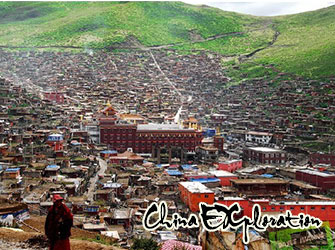
The organizational structure of the major Tibetan monasteries was traditionally based on three levels: Labrang, Dratsang, and Khangtsen. The Labrang was the highest administrative organization of the monastery; the Dratsang was the middle-level and core organizational unit; and the Khangtsen formed the basic community and residential unit
The three great monasteries of Lhasa—Drepung, Sera, and Ganden—were each composed of two or more Dratsangs. Dratsangs were generally established according to different branches of Buddhist study, particularly Exoteric Buddhism and Tantric Buddhism. In larger monasteries, each of these traditions could be further divided into several Dratsangs. For example, Drepung Monastery had three Exoteric Dratsangs and one Tantric Dratsang, while Sera Monastery had two Exoteric Dratsangs and one Tantric Dratsang. Ganden Monastery had two Exoteric Dratsangs.
Dratsangs within the same monastery could differ considerably in their curricula, rules, administrative systems, and even their external relationships. These differences reflected the relatively high degree of organizational independence enjoyed by individual Dratsangs.
Khenpo Lama and Dratsang Administration
The Khenpo Lama was the head of a Dratsang and was responsible for managing its religious education, administrative affairs, property, and other resources. In the traditional system, the Khenpo Lama could also become involved in important matters concerning the local Tibetan government. The Khenpo Lama of an influential Dratsang not only headed his own Dratsang but could also serve as a member of the leadership of the monastery as a whole.
In the three great monasteries, Khenpo Lamas were appointed by the Tibetan government, generally from among trusted individuals who had attained the Geshe degree. A Khenpo Lama normally served for approximately six or seven years and could be reappointed.
The Khenpo Lama appointed several senior monks to assist with the daily administration of the Dratsang. Among them were the Labrang Gyatso, Guige, and Xionglaiba.
The Labrang Gyatso served as the Khenpo Lama's chief administrator, overseeing administrative affairs, property, dependents, and external relations. A Khenpo Lama was entitled to establish a private residence and administrative household known as a Labrang, whose property was traditionally placed under his personal control.
The Guige was responsible for maintaining order within the Dratsang and resolving disputes among monks on behalf of the Khenpo Lama. The Wontze was responsible for leading collective scripture chanting, while the Xionglaiba supervised the monks' religious studies and their preparation for examinations for the Geshe degree.
Khangtsen: The Basic Community of the Monastery
The Khangtsen was the basic organizational and residential unit of a monastery. It had a strong regional character: monks from the same area, or monks with family or regional connections, would generally belong to the same Khangtsen.
For monks, the Khangtsen functioned not only as a place of residence but also as a kind of extended family and social community. The size and economic strength of Khangtsens varied considerably. A large Dratsang could contain numerous Khangtsens. For example, the Loseling Dratsang of Drepung Monastery was traditionally composed of 23 Khangtsens.
The actual status and influence of a Khangtsen depended greatly on its wealth, property, and the influence of its monks. In some cases, a wealthy and powerful Khangtsen could even possess greater practical influence than a relatively poor Dratsang.
Each Khangtsen had an administrative committee responsible for its routine affairs. The senior monk, known as the Gigen, presided over the Khangtsen and coordinated its internal affairs.
Together, the Labrang, Dratsang, and Khangtsen formed a distinctive hierarchical and community-based organizational structure that shaped the religious, educational, economic, and social life of traditional Tibetan monasteries.