Sky Burial
Sky burial is one of the traditional Tibetan funerary practices. It reflects important Buddhist beliefs concerning impermanence, compassion, and the cycle of life and death.
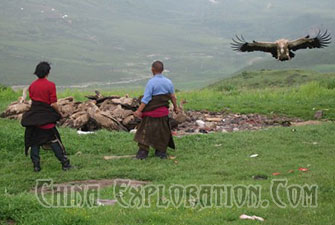
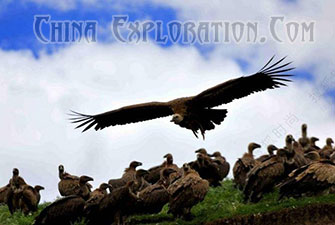
At a high-altitude burial site, often located on a rocky ridge and surrounded by prayer flags, a specialist known as a tomden performs the traditional rites. After the body has been prepared, it is offered to vultures, which are regarded in Tibetan Buddhist tradition as sacred birds and are sometimes associated with dakinis, spiritual beings connected with the sky and the transition between life and death.
As the vultures gather around the burial site, the tomden performs the prescribed ritual procedures and offers the body to the birds. From the Buddhist perspective, the physical body is no longer needed after death. Offering it to other living beings is therefore regarded as an act of generosity and compassion.
Once the body has been consumed, the remaining bones are traditionally processed and offered to the birds as well. Throughout the ceremony, prayers and mantras may be recited.
The practice expresses the Buddhist understanding that the physical body is impermanent, while the cycle of existence continues through death, rebirth, and eventual liberation. The sight of vultures rising from a remote mountain ridge into the vast Tibetan sky has consequently become one of the most powerful images associated with Tibetan funerary culture.
About the Reincarnation of Living Buddhas
The reincarnation of high-ranking Buddhist masters, commonly referred to in English as the “Living Buddha” reincarnation system, is a distinctive institution that developed within Tibetan Buddhism. According to the tradition, when an eminent Buddhist teacher dies, disciples may search for a child believed to be the master's reincarnation.
The origins of this system can be traced to the Karma Kagyu school in the late 13th century. In Tibetan Buddhism, the idea is based on the belief that an enlightened master can consciously return through reincarnation in order to continue his religious mission and benefit sentient beings.
In 1252, the Mongol prince Kublai Khan met the Tibetan Buddhist master Phagpa, a leading figure of the Sakya school. Kublai Khan later established a close relationship with Phagpa, who became an influential religious figure in the Yuan court.
Another important Tibetan Buddhist master of the period was Karma Pakshi, the second Karmapa of the Karma Kagyu tradition. He received the patronage of Möngke Khan and was associated with the famous Black Hat tradition of the Karmapas.
Before his death in 1283, Karma Pakshi is traditionally said to have left instructions concerning his successor. His disciples subsequently searched for a child who was regarded as his reincarnation. This marked an important milestone in the development of the Karmapa reincarnation lineage and the institutionalization of reincarnation within Tibetan Buddhism.
During the Ming Dynasty (1368–1644), the imperial court recognized the Karmapa and granted important honorific titles to the lineage. The Karmapa became one of the most influential reincarnate lama lineages in Tibetan Buddhism.
The reincarnation institution subsequently spread to other Tibetan Buddhist schools. Over time, a number of major reincarnation lineages developed, including the Dalai Lama and Panchen Lama lineages of the Gelug school.
The recognition of a reincarnated lama traditionally involves religious rituals, divination, consultation with senior monks, and the examination of signs associated with the deceased master. In some major lineages, political authorities have also historically played a role in the formal recognition process.
Today, the reincarnation tradition remains an important feature of Tibetan Buddhist religious culture and continues to attract interest from scholars and visitors seeking to understand the distinctive spiritual traditions of the Tibetan Plateau.