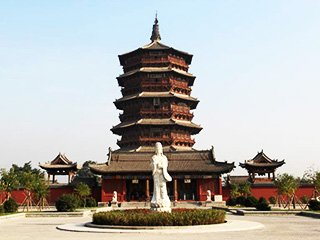
Ying County Wooden Pagoda (应县木塔, Yìngxiàn Mùtǎ), officially known as the Sakyamuni Pagoda of Fogong Temple, is one of the greatest architectural achievements of ancient China. Located in the northwestern part of Ying County, Shanxi Province, the pagoda is the oldest and tallest fully wooden pagoda still standing in China and is also regarded as the tallest ancient wooden structure in the world.
Built entirely from timber without using nails, the pagoda represents the remarkable craftsmanship, engineering skills, and religious culture of the Liao Dynasty (916–1125).
Standing at 67.31 meters high, the Ying County Wooden Pagoda has survived nearly 1,000 years of history, earthquakes, and natural challenges, making it a masterpiece of ancient Chinese architecture.
History of Ying County Wooden Pagoda
The pagoda was constructed in 1056 during the Liao Dynasty inside Fogong Temple, originally built as a Buddhist structure dedicated to Sakyamuni Buddha, the historical founder of Buddhism.
The pagoda stands on a four-meter-high stone platform decorated with Liao Dynasty-style stone sculptures, including carved lions around the edges and corners. These simple yet powerful sculptures reflect the artistic characteristics of the Liao period.
Over centuries, the pagoda has remained an important Buddhist landmark and a symbol of ancient Chinese wooden architecture.
Architectural Features of the Wooden Pagoda
The Ying County Wooden Pagoda is an octagonal structure with a unique design combining religious symbolism and advanced construction techniques.
Although the exterior appears to have five stories, the interior actually contains nine levels, including four hidden storeys built within the structure.
Key architectural features include:
* Height: 67.31 meters
* Base diameter: 30.27 meters
* Shape: Octagonal wooden structure
* Construction material: Timber only
* Built date: 1056 (Liao Dynasty)
The first floor features two layers of roofs and a magnificent interior space. Upon entering through the southern entrance, visitors can see a large statue of Sakyamuni Buddha, approximately 10 meters high.
The interior decorations include:
* Beautiful caisson ceilings
* Buddhist murals
* Images of heavenly kings
* Warrior guardians
* Buddhist disciples
Many of these artworks preserve the distinctive style of the Liao Dynasty.
 Panoramic Views from the Pagoda
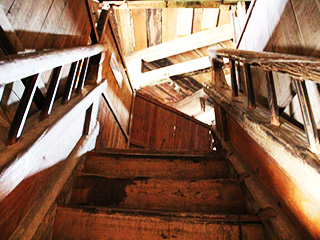
Wooden staircases inside the pagoda lead visitors to the upper levels. From the second floor upward, each level features windows facing eight directions, allowing visitors to enjoy views of the surrounding landscape.
The balconies around each floor provide excellent viewpoints overlooking:
* Ying County town
* Mount Hengshan
* Sanggan River area
The combination of ancient architecture and surrounding scenery creates a unique cultural and visual experience.
A Thousand Years of Earthquake Resistance
One of the most remarkable aspects of Ying County Wooden Pagoda is its extraordinary durability.
For almost a millennium, the pagoda has survived numerous earthquakes. Historical records mention that during a major earthquake lasting seven days in the Yuan Dynasty, the structure remained standing.
Even during major earthquakes in nearby regions, including the Xingtai earthquake, Tangshan earthquake, and Helinger earthquake, the pagoda suffered little damage.
Its survival demonstrates the advanced understanding of wooden structures and earthquake-resistant techniques achieved by ancient Chinese craftsmen.
Precious Cultural Relics Discovered Inside
Since the founding of the People’s Republic of China, extensive research and preservation work has been carried out on the pagoda.
During restoration work in 1974, numerous valuable cultural relics were discovered inside, including:
* Buddhist scriptures
* Ancient manuscripts
* Liao Dynasty paintings
* Medical illustrations
* Printed and handwritten scripture scrolls
Some scrolls are more than 30 meters long, with some dating back to the years 990, 1003, and 1071.
These discoveries provide important information for studying:
* Buddhist culture in ancient China
* The development of printing technology
* Cultural exchanges among different ethnic groups in Chinese history
Why Visit Ying County Wooden Pagoda?
The Ying County Wooden Pagoda is not only a Buddhist monument but also a symbol of China’s ancient engineering achievements.
Visitors can admire:
* The world’s tallest surviving ancient wooden pagoda
* Nearly 1,000 years of architectural history
* Liao Dynasty Buddhist art
* Remarkable earthquake-resistant design
* Rare historical manuscripts and relics
For travelers interested in Chinese history, architecture, Buddhism, and ancient craftsmanship, Ying County Wooden Pagoda is one of Shanxi Province’s most unforgettable cultural attractions.