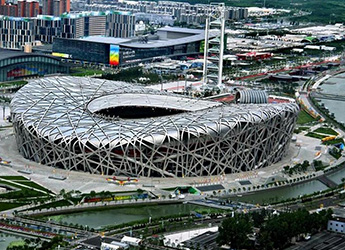
The Beijing National Stadium, widely known as the Bird’s Nest, is one of the most iconic modern architectural landmarks in China. Built for the 2008 Beijing Olympic Games, the stadium attracted worldwide attention with its unique design, impressive scale, and innovative engineering.
Located in the Olympic Park of northern Beijing, the Bird’s Nest has become a symbol of China’s modernization and a must-see attraction for visitors exploring Beijing’s Olympic heritage.
The stadium’s circular shape represents “Heaven” in traditional Chinese culture, while the nearby National Aquatics Center (Water Cube) reflects the Chinese concept of “Earth” through its square shape. Together, these two Olympic venues create a meaningful combination of traditional Chinese philosophy and contemporary architecture.
The Main Venue of the 2008 Beijing Olympics
The Bird’s Nest served as the main stadium for the 2008 Beijing Olympic Games, hosting some of the most important events of the competition.
During the Olympics, the stadium accommodated approximately 91,000 spectators and hosted:
* The opening ceremony of the 2008 Beijing Olympic Games
* Track and field competitions
* The men’s football final
* The closing ceremony
The stadium also hosted the 2008 Beijing Paralympic Games, including athletics competitions and opening and closing ceremonies.
After the Olympics, temporary seats were removed, reducing the capacity to around 80,000 seats. Today, the Bird’s Nest continues to host international sporting events, cultural performances, exhibitions, and large-scale celebrations.
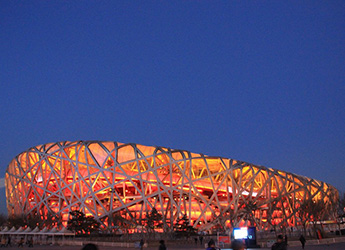 Unique Architectural Design
The Bird’s Nest received its nickname because of its distinctive steel structure, which resembles the interwoven branches of a bird’s nest. The design was inspired by traditional Chinese crazed pottery patterns, creating a seemingly random yet carefully calculated structural appearance.
The stadium’s design combines artistic creativity with advanced engineering. Instead of building the outer structure first, architects designed the seating bowl as the core element and then created the surrounding steel framework around it. This approach ensures that spectators have excellent views of the events while maintaining a compact and efficient structure.
The complex steel framework gives the stadium its unforgettable appearance, making it one of the most recognizable buildings in the world.
Advanced Engineering and Safety Features
Beijing is located in an area with significant seismic activity, so earthquake resistance was a major consideration during the stadium’s construction.
Engineers used advanced seismic analysis technology to test the Bird’s Nest under different earthquake conditions. The final design provides strong structural stability and allows the stadium to withstand major seismic forces.
The combination of innovative engineering, cultural symbolism, and artistic design has made the Bird’s Nest an outstanding example of modern Chinese architecture.
Visiting the Bird’s Nest Today
The Bird’s Nest is now one of Beijing’s most popular attractions, especially for visitors interested in architecture, sports history, and the legacy of the Olympic Games.
Located near other famous Olympic landmarks such as the Water Cube, the stadium is particularly impressive when illuminated at night. Visitors can explore the Olympic Park, admire the unique structure from outside, or enter the stadium to experience the atmosphere of one of the world’s most famous sporting venues.