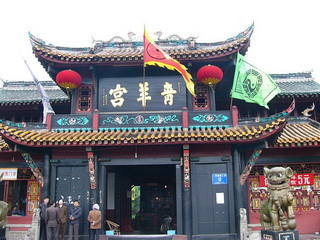
Located in the western part of Chengdu City, Sichuan Province, Qingyang Palace (Qing Yang Gong), also known as the Green Goat Temple, is the oldest and largest Taoist temple in Southwest China. With a history of more than a thousand years, it is one of Chengdu’s most important cultural and religious landmarks.
Originally built during the early Tang Dynasty (618–907), the temple has undergone numerous renovations and reconstructions throughout history. Most of the existing buildings date back to the Qing Dynasty (1644–1911), preserving the traditional style of Taoist architecture.
History and Taoist Legends
According to Taoist legend, Qingyang Palace is closely associated with Lao Tzu (Laozi), the founder of Taoism. It is believed to be the place where Lao Tzu was born and where he delivered his first teachings on Taoism.
Since ancient times, the temple has been regarded as a sacred place where Taoist immortals gathered. Historical records show that two emperors of the Tang Dynasty visited the temple, and one of them is said to have given the temple its name.
Because of its connection with Taoist traditions and imperial history, Qingyang Palace has become an important cultural heritage site in Chengdu.
Taoist Architecture and Main Buildings
Qingyang Palace contains numerous buildings featuring distinctive Taoist architectural styles, including:
* Mountain Gate
* Sanqing Palace (Three Purities Hall)
* Bagua Pavilion
* Eight Trigrams Pavilion
* Various courtyards and gardens
The main halls are decorated with exquisite carvings and traditional artwork. Inside one of the halls are beautifully carved panels depicting the Eight Immortals of Taoism, each riding their symbolic animals.
The temple also contains statues of important Taoist figures, including the Three Purities (Sanqing), the highest-ranking deities in Taoism.
The Legendary Brass Goats
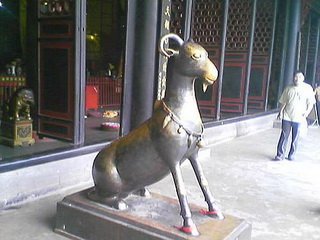
The most famous treasures of Qingyang Palace are the two brass mythological goats located in Sanqing Palace.
According to legend, these creatures represent a combination of all twelve Chinese zodiac animals. Visitors believe that touching the goats can bring blessings of health, happiness, and longevity.
Because generations of visitors have rubbed their heads for good fortune, the surface of the brass goats has become smooth over time.
Cultural Highlights of Qingyang Palace
Several important sites inside the temple are connected with Taoist legends:
* Zijin Platform – believed to be the birthplace of Lao Tzu
* Teaching Platform – associated with Lao Tzu’s first Taoist sermon
* Sanqing Palace – home to the statues of the Three Purities
At the entrance, the mountain gate displays the inscription “Qingyang Palace”, said to have been written by an important official of the Tang Dynasty. The gate is decorated with colorful animal sculptures carved on stone pillars and roof details, showcasing the beauty of traditional Chinese craftsmanship.
Tea Culture and Temple Life
Besides its religious buildings, Qingyang Palace also features peaceful gardens, traditional courtyards, a vegetarian restaurant, and Chengdu-style teahouses.
The temple provides visitors with a relaxing cultural experience where they can:
* Appreciate Taoist architecture
* Enjoy traditional tea culture
* Explore ancient gardens
* Experience Chengdu’s leisurely lifestyle
Every spring, cultural events such as flower festivals, temple fairs, and lantern celebrations are held around the temple, attracting both locals and visitors.
Visit Qingyang Palace
With its ancient trees, incense-filled halls, elegant architecture, and deep Taoist traditions, Qingyang Palace offers a peaceful escape in the heart of Chengdu.
For travelers interested in Chinese philosophy, religion, architecture, and local culture, Qingyang Palace is one of the best places to experience the spiritual heritage of Sichuan.