




search for a Trip
Wuyishan Mountain National Park
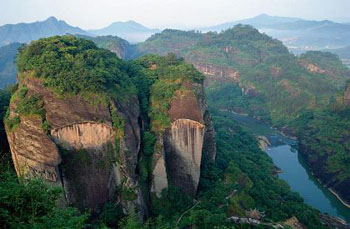 The Wuyi Mountains have a geological history dating back more than a billion years. Over countless geological periods, tectonic movements and erosion gradually shaped the dramatic mountains, deep valleys and distinctive peaks seen today. Dense forests cover much of the mountain slopes, while exposed peaks and rocky formations create a striking contrast across the landscape.
Located in northern Fujian Province in southeastern China, Wuyi Mountains National Park is characterized by a remarkable variety of landforms. Long-term geological movements, particularly major tectonic changes during the Quaternary Period, caused different parts of the region to rise at varying rates. This created significant differences in elevation, with a vertical drop of more than 1,700 meters between the summit of Mount Huanggang and the surrounding valley floors.
Main Scenic Highlights
Intricate Mountain Terrain
Wuyi Mountains National Park is a landscape of dramatic peaks, deep valleys, quiet rivers and lush forests. Its complex terrain can generally be divided into three major forms: isolated mountains and individual peaks, deep gorges, and small mountain basins shaped by the continuous erosion of rivers.
The combination of mountains, gorges, valleys and basins has created a wide variety of ecological environments. These diverse habitats support an extraordinary range of plant and animal species.
The warm, humid climate and complex terrain provide ideal conditions for well-preserved subtropical ecosystems. The park is home to approximately 1,815 species of vascular plants, including trees, shrubs, flowers and herbs from different geographical regions.
A Sanctuary for Wildlife
Covering an area of approximately 56,527 hectares, Wuyi Mountains National Park contains a rich mosaic of forests, rivers, wetlands and other natural habitats. The park is particularly famous for its exceptional bird diversity.
More than 400 species of birds have been recorded in the Wuyi Mountains, representing a significant proportion of China’s bird species. During seasonal migrations, numerous birds can be observed throughout the park, making the region an excellent destination for birdwatching and nature enthusiasts.
Guadun is particularly well known for its rich birdlife and has earned a reputation as a “Kingdom of Birds.” Species such as the white-backed woodpecker can be found in the area, while ponds and forest habitats provide important feeding and breeding grounds for many other birds.
The park is also home to numerous mammals, amphibians and reptiles, including some rare species. Its exceptional diversity has made Wuyi Mountains an important location for scientific research into the ecology and conservation of Asian amphibians and reptiles.
Stunning Natural Landscapes
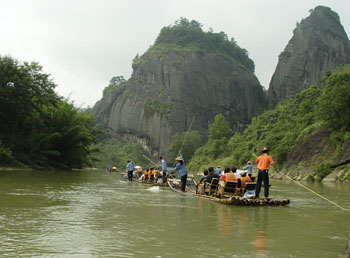 Wuyi Mountains National Park is renowned for its pristine landscapes, including dramatic peaks, caves, unusual rock formations, springs, ponds and winding rivers. Farmland and picturesque villages surrounding the mountains add to the peaceful character of the region.
Among all the natural attractions, the Jiuqu River is perhaps the most famous. The river winds gently through the mountains, with clear blue-green water flowing between picturesque peaks, valleys, cliffs and unusual rock formations.
A boat journey along the Jiuqu River provides one of the best ways to appreciate the scenery. As the river changes direction around each bend, visitors can enjoy constantly changing views of the surrounding mountains and forests.
Cultural and Historical Heritage
The Wuyi Mountains have a long and important cultural history. Since ancient times, the region has attracted scholars, philosophers and religious practitioners. As early as the Qin Dynasty period, scholars traveled to the mountains to study and give lectures, while Taoist practitioners also came here to pursue spiritual practices.
Historically, numerous temples, palaces, pavilions and other structures were built on or around the mountains and along the river. Although many of these buildings have disappeared over the centuries, several historic sites and ruins remain.
One particularly important cultural site is associated with Zhu Xi, one of China’s most influential philosophers and Neo-Confucian scholars. He taught and lectured in the Wuyi Mountains for many years, leaving a lasting cultural legacy in the region.
The combination of ancient academic traditions, religious heritage and spectacular natural scenery makes Wuyi Mountains significant not only as a natural destination but also as an important center of Chinese history and culture.
Travel to Wuyi Mountains
Wuyi Mountains can be visited throughout the year and are accessible by air, rail and road. Wuyishan Airport and railway services provide convenient connections with major cities in China, while buses and local transportation connect the main scenic areas.
The region offers a range of accommodation and dining options, from traditional hotels to modern resorts. Local specialties include fresh river fish, seasonal fruits and other regional dishes.
During the summer season, visitors may also enjoy cultural performances and outdoor activities. With its lush forests, clear rivers, pleasant mountain climate and rich cultural heritage, Wuyi Mountains is a popular destination for families, nature lovers and travelers seeking a peaceful escape in southeastern China.
Related Tours:
China Attractions Guide
- Anhui Attractions
- Beijing Attractions
- Chongqing Attractions
- Fujian Attractions
- Gansu Attractions
- Guangdong Attractions
- Guangxi Attractions
- Guizhou Attractions
- Hainan Attractions
- Henan Attractions
- Hongkong Attractions
- Hubei Attractions
- Hunan Attractions
- Heilongjiang Attractions
- Inner Mongolia Attractions
- Jiangsu Attractions
- Jilin Attractions
- Jiangxi Attractions
- Liaoning Attractions
- Manchuria Attractions

