




search for a Trip
Fanjingshan National Nature Reserve
Mount Fanjing, also known as Fanjingshan, is one of the most remarkable natural and cultural destinations in Guizhou Province, China. Fanjingshan National Nature Reserve was established in 1978 with the approval of the Guizhou provincial government. In 1986, it was designated as a national nature reserve and was also included in UNESCO’s Man and the Biosphere Programme. Today, Mount Fanjing is renowned for its exceptional biodiversity, spectacular mountain landscapes and long-standing Buddhist heritage.
Located at the junction of Yinjiang, Jiangkou and Songtao counties in northeastern Guizhou Province, Mount Fanjing is one of the main peaks of the Wuling Mountain Range. The nature reserve covers an area of approximately 567 square kilometers (219 square miles), much of which is covered by well-preserved natural vegetation and forest.
Rich Biodiversity
Fanjingshan National Nature Reserve is an important natural treasure with exceptionally rich plant and wildlife resources. Around 80% of the protected area is covered by virgin forest and other natural vegetation. The region is home to a remarkable variety of plant species, including rare and endemic plants such as the Chinese dove tree, whose distinctive flowers make it one of the most fascinating species found in the area.
Because of its subtropical alpine monsoon climate and considerable differences in elevation, Mount Fanjing features distinct vertical vegetation zones. As visitors climb higher into the mountains, the vegetation gradually changes from evergreen broad-leaved forests to deciduous forests and other alpine plant communities. This diversity of habitats contributes greatly to the area’s outstanding ecological value.
The favorable climate, abundant water resources and dense vegetation also provide an ideal habitat for a wide range of wildlife. More than 800 species of wild animals have been recorded in the reserve, including mammals, birds, reptiles and amphibians. Among them, several species are rare or endangered and are under national protection.
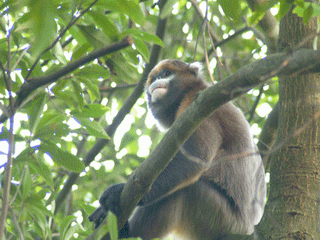
The Guizhou snub-nosed monkey, also known as the Guizhou golden monkey, is the most famous animal associated with Mount Fanjing. This rare primate is endemic to the region and is one of China’s most protected wildlife species. Its survival is closely connected with the well-preserved forests of Fanjingshan. Other protected species have also been recorded in the wider region, further highlighting the importance of the reserve for wildlife conservation.
The biodiversity of Fanjingshan is exceptional for a mountain area at this latitude. Its extensive forests and relatively undisturbed ecosystems make it one of China’s most important subtropical forest conservation areas. Green mountains, clear streams, mist-covered peaks and abundant wildlife combine to create a unique natural environment.
A Sacred Buddhist Mountain
In addition to its natural beauty, Mount Fanjing is an important Buddhist site in China. The mountain has been associated with Buddhism since the Ming Dynasty, and its religious significance has developed over several centuries. According to local tradition, the name “Fanjing” refers to a pure land associated with Buddhism.
The peaceful surroundings, dramatic rock formations and frequently mist-covered peaks create a spiritual atmosphere that has attracted Buddhist pilgrims and visitors for generations. Numerous temples and religious sites can be found throughout the mountain, with those associated with Maitreya and Sakyamuni among the most notable.
Mount Fanjing’s combination of dramatic natural scenery and Buddhist culture makes it more than simply a mountain destination. Visitors can experience both the tranquility of the natural environment and the cultural traditions that have shaped the mountain’s identity over centuries.
The Main Peaks of Mount Fanjing
Mount Fanjing is famous for its distinctive peaks and spectacular rock formations. The mountain’s major summits include the Old Golden Summit, Fenghuang (Phoenix) Summit and New Golden Summit. More than 8,000 stone steps lead from the lower sections of the mountain toward the summit areas, making the climb a challenging but rewarding experience.
The winding mountain paths pass through dense forests and dramatic landscapes. Along the way, visitors can enjoy changing views of cliffs, valleys, forests and clouds. For hikers and nature lovers, the journey to the summit is an important part of the Mount Fanjing experience.
Hongyun Golden Summit and Sea of Clouds
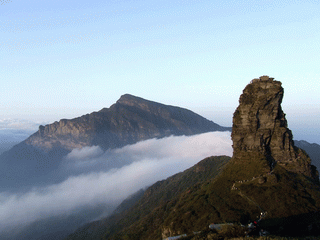
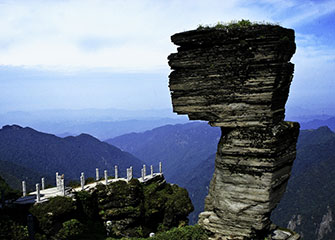
Hongyun Golden Summit, one of the most iconic landmarks of Mount Fanjing, is particularly famous for its dramatic scenery. The narrow rocky peak rises high above the surrounding mountains and is often surrounded by clouds and mist.
When weather conditions are favorable, visitors may enjoy a spectacular sea of clouds stretching across the mountain landscape. Sunlight filtering through the mist can create beautiful halos and colorful atmospheric effects around the summit. Traditionally regarded as auspicious, these phenomena add an almost magical quality to the scenery.
With its extraordinary biodiversity, pristine subtropical forests, Buddhist heritage and breathtaking mountain landscapes, Mount Fanjing is one of Guizhou’s most distinctive natural and cultural destinations. It offers visitors an opportunity to experience China’s rich ecological heritage while discovering the spiritual and cultural traditions that have developed around this sacred mountain.
Related Tours:
China Attractions Guide
- Anhui Attractions
- Beijing Attractions
- Chongqing Attractions
- Fujian Attractions
- Gansu Attractions
- Guangdong Attractions
- Guangxi Attractions
- Guizhou Attractions
- Hainan Attractions
- Henan Attractions
- Hongkong Attractions
- Hubei Attractions
- Hunan Attractions
- Heilongjiang Attractions
- Inner Mongolia Attractions
- Jiangsu Attractions
- Jilin Attractions
- Jiangxi Attractions
- Liaoning Attractions
- Manchuria Attractions

