





search for a Trip
Dafeng Milu National Nature Reserve
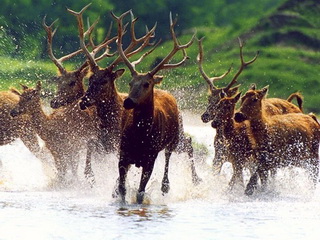
Dafeng Milu National Nature Reserve, located in Yancheng, Jiangsu Province, is one of China’s most important conservation areas for the Père David’s deer, known as Milu (麋鹿) in Chinese. The reserve was established to protect, breed and reintroduce this rare deer species to its natural habitat.
The reserve forms part of the broader coastal wetland ecosystem of Yancheng, an important habitat for many species of wildlife and migratory birds. The surrounding wetlands provide valuable habitats for birds, fish, insects and other animals, making the area an important destination for wildlife conservation and ecological tourism.
Dafeng Milu National Nature Reserve has gained international recognition for its successful conservation and reintroduction efforts. Its development has involved cooperation between local authorities and international environmental organizations, contributing to the protection of China’s unique wetland ecosystems and endangered wildlife.
Père David’s Deer: The Milu
The Père David’s deer (Elaphurus davidianus), known as Milu in Chinese, is a distinctive species of deer native to China. Adult deer generally weigh between 150 and 200 kilograms. Unlike many other deer species, Milu are well adapted to wetlands and marshes. They are excellent swimmers and feed on a mixture of grasses, reeds and aquatic plants.
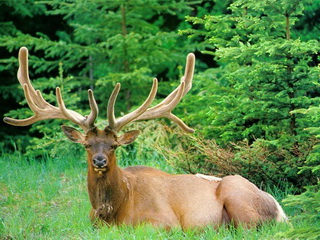
The species has several unusual physical characteristics. It has a long tail, broad hooves and large, branched antlers. Adult males develop impressive antlers, while the coat changes with the seasons. Summer coats are generally reddish-brown with a darker stripe along the back, while winter coats become darker and thicker. Young deer are usually spotted.
Père David’s deer have a relatively long gestation period of around nine months, and females generally give birth to one or two fawns. Under suitable conditions, they can live for more than 20 years.
Why Is the Milu Called “Four Unlikes”?
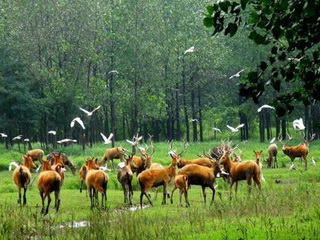 The Milu has a unique appearance that does not resemble any other deer species exactly. In Chinese, it is popularly known as “Sibuxiang” (四不象), meaning “four unlikes.”
According to the traditional description, the animal has the hooves of a cow but is not a cow, the head of a horse but is not a horse, the antlers of a deer but is not a deer, and the body of a donkey but is not a donkey.
This unusual combination of physical characteristics has made the Milu one of the most distinctive and fascinating animals in Chinese wildlife.
The Natural Habitat of the Milu
Père David’s deer are believed to have originally inhabited the swampy, reed-covered wetlands of eastern and northeastern China. Unlike many other deer species, Milu are particularly comfortable in water and are strong swimmers.
The species disappeared from the wild in China centuries ago, largely as a result of habitat loss and hunting. For many years, the remaining animals survived only in managed populations.
In the 19th century, French missionary and naturalist Father Armand David encountered Milu in the imperial hunting park near Beijing. His observations brought the species to the attention of European scientists, and several animals were subsequently transported to Europe.
The Chinese population eventually disappeared from the country in the early 20th century. The remaining animals in Europe, however, survived and formed the basis for later conservation efforts.
 Reintroduction of the Milu to China
One of the most remarkable chapters in the history of Père David’s deer began in the late 1980s, when Milu were returned to China from overseas populations and reintroduced to suitable habitats.
Dafeng Milu National Nature Reserve became one of the most important sites for this reintroduction program. The coastal wetlands of Dafeng provide an ideal environment for the deer, with extensive grasslands, reeds, shallow water and open spaces.
The reintroduced Milu adapted successfully to the local environment and reproduced naturally. Over time, the population increased significantly, transforming Dafeng into one of the world’s most important conservation and breeding centers for Père David’s deer.
Today, visitors to the reserve can observe herds of Milu living in a semi-natural wetland environment. The reserve provides an excellent opportunity to learn about wildlife conservation while experiencing the unique landscapes of the Jiangsu coast.
Dafeng Milu National Nature Reserve
The reserve is more than simply a sanctuary for deer. Its extensive wetlands support a wide variety of plants and animals and form part of the important coastal ecosystems of Yancheng.
Visitors can explore the reserve’s natural landscapes, observe Milu in their habitat and learn about the history of this remarkable species. The combination of wildlife, wetlands and conservation education makes Dafeng Milu National Nature Reserve an interesting destination for nature lovers, families and visitors interested in China’s environmental protection efforts.
The successful return of Père David’s deer to China is an inspiring example of international cooperation in wildlife conservation. From near extinction in the wild to thriving populations in protected areas, the story of the Milu demonstrates the importance of habitat protection, scientific conservation and long-term environmental management.
Related Tours:
China Attractions Guide
- Anhui Attractions
- Beijing Attractions
- Chongqing Attractions
- Fujian Attractions
- Gansu Attractions
- Guangdong Attractions
- Guangxi Attractions
- Guizhou Attractions
- Hainan Attractions
- Henan Attractions
- Hongkong Attractions
- Hubei Attractions
- Hunan Attractions
- Heilongjiang Attractions
- Inner Mongolia Attractions
- Jiangsu Attractions
- Jilin Attractions
- Jiangxi Attractions
- Liaoning Attractions
- Manchuria Attractions

