




search for a Trip
Alxa League
 Alxa League is located in the westernmost part of the Inner Mongolia Autonomous Region in northern China. Covering approximately 270,000 square kilometers, it is the largest prefecture-level administrative area in Inner Mongolia while having a relatively small population.
Alxa is administered through three banners: Alxa Left Banner, Alxa Right Banner and Ejina Banner. The region is home to people from several ethnic groups, including Mongolian, Han and Hui communities, creating a diverse cultural landscape.
With its vast deserts, Gobi landscapes, snow-capped mountains, ancient forests and fascinating historical sites, Alxa is one of the most distinctive destinations in western Inner Mongolia.
Helan Mountains and the Gobi Landscape
The Helan Mountains form an important natural landscape in the eastern part of Alxa. Rising dramatically above the surrounding desert and Gobi, the mountains support forests and provide important habitats for a variety of wild plants and animals.
Beyond the mountains stretches an immense Gobi landscape characterized by rugged terrain, unusual rock formations and vast open spaces. The contrast between the mountains and surrounding desert creates some of the most striking scenery in Alxa.
For travelers interested in geology, photography and wilderness landscapes, the region offers a remarkable opportunity to experience the diversity of northwestern China’s natural environment.
The Ancient Populus Euphratica Forest
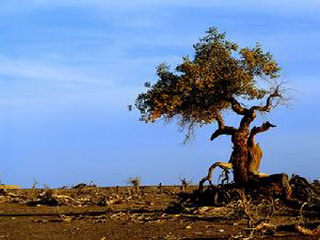
One of the most iconic landscapes of Alxa is the Populus euphratica forest, particularly the famous forests of Ejina Banner.
Populus euphratica, also known as the desert poplar, is remarkably well adapted to the harsh conditions of arid regions. The trees can survive extreme temperatures, drought and salty soils.
A traditional saying describes the resilience of these trees as living for a thousand years, remaining standing for another thousand years after death and enduring for another thousand years after falling. Although poetic rather than scientific, the saying reflects the extraordinary durability of the species.
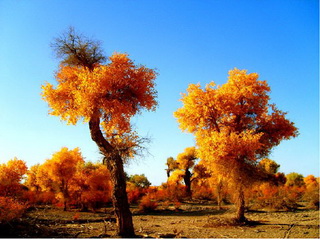
In autumn, the leaves of the Populus euphratica turn brilliant golden yellow, creating spectacular scenery against the surrounding desert. The forests have become one of the most photographed landscapes in Inner Mongolia.
 Badain Jaran Desert
The Badain Jaran Desert is one of Alxa’s most famous natural attractions and one of the most spectacular desert landscapes in China.
It is renowned for its enormous sand dunes, some of which rise to extraordinary heights, as well as the unusual combination of towering dunes and desert lakes. These natural features create an otherworldly landscape of golden sand, blue water and vast open skies.
Badain Jaran is often described as the “Kingdom of Sand Dunes” because of its immense dunes and distinctive desert topography. The combination of high dunes and scattered lakes makes the desert particularly unusual compared with many other deserts around the world.
The desert forms the core of the Badain Jaran Desert National Geopark and is one of the major attractions for travelers exploring Alxa.
Desert Lakes and Moon Lake
Among the many remarkable landscapes of Alxa are its desert lakes. Surrounded by vast expanses of sand, these isolated bodies of water create striking contrasts within the arid environment.
Moon Lake, located in the Tengger Desert, is one of the best-known desert attractions in the region. Its distinctive shape and surrounding dunes make it a popular destination for desert sightseeing and outdoor activities.
The combination of golden sand, blue water and clear skies creates a particularly beautiful landscape, especially around sunrise and sunset.
Buddhist Temples and Mongolian Culture
Alxa is also rich in cultural and religious heritage. The region has a long connection with Tibetan Buddhism, and several important temples can be found among its mountains and deserts.
Guangzong Temple, also known as South Temple, and Fuyin Temple, known as North Temple, are among the notable religious sites in the region.
These temples provide opportunities to learn about Tibetan Buddhist traditions and the religious history of the Mongolian communities of western Inner Mongolia.
Traditional festivals, local customs and Mongolian cultural traditions further enrich the travel experience, allowing visitors to discover a side of Inner Mongolia that extends far beyond its famous grasslands.
Geological and Archaeological Heritage
The extraordinary geology of Alxa has created numerous unusual rock formations, valleys and canyons. Attractions such as Guaishiyuan, or the Grotesque Rock Garden, and Shenshigou, or Mysterious Stone Valley, showcase the region’s fascinating geological features.
Alxa is also important for archaeological research. The ruins associated with the Western Xia civilization and the ancient Juyan culture provide valuable evidence of the region’s long history as a meeting point between different civilizations.
These archaeological sites add a historical dimension to a journey through the deserts and Gobi, demonstrating that Alxa has been an important cultural crossroads for centuries.
Discover the Mysterious Wonderland of Alxa
Alxa League offers an extraordinary combination of natural and cultural attractions. From the towering dunes and hidden lakes of the Badain Jaran Desert to the golden Populus euphratica forests of Ejina, from the rugged Helan Mountains to ancient temples and archaeological sites, the region presents a remarkably diverse landscape.
For travelers looking for desert adventures, photography, geology, wildlife, Mongolian culture and ancient history, Alxa is an exceptional destination in western Inner Mongolia.
Its immense landscapes and relatively remote location give Alxa a strong sense of wilderness, making it an ideal place to experience the dramatic beauty and cultural richness of China’s northwest.
Related Tours:
China Attractions Guide
- Anhui Attractions
- Beijing Attractions
- Chongqing Attractions
- Fujian Attractions
- Gansu Attractions
- Guangdong Attractions
- Guangxi Attractions
- Guizhou Attractions
- Hainan Attractions
- Henan Attractions
- Hongkong Attractions
- Hubei Attractions
- Hunan Attractions
- Heilongjiang Attractions
- Inner Mongolia Attractions
- Jiangsu Attractions
- Jilin Attractions
- Jiangxi Attractions
- Liaoning Attractions
- Manchuria Attractions

