Tibetan Buddhism was originated from India , but it also aborted the theory from its local religion Bon during their long time’s crucial fights. The incarnation was learned from Bon. And it also fell into many big or small sections because of their difference in understanding the Buddhism theory and their unique history. But generally we divided the religion in big schools as below:
Gelugpa School ( Yellow School ):
It is the largest school of Tibetan Buddhism now. This is lineage combines the teachings and practices of the Nyingma, Kagyu and Sakya with the Sutra and Tantra systems of Indian Buddhism and the intellectual heritage of Nagarjuna and Asanga. It was founded by Gyalwa Tsongkhapa (1357-1419) And Tsongkhapa's disciple, Gyalwa Gedun Drupa was the first of the fourteen successive rebirths of the Dalai Lama.
Sakya School :
The Sakya tradition originated in the eleventh century, and has been closely associated with the Khon Family. Khon Lui Wangpo Sungwa became a disciple of Guru Rinpoche in the eighth century. Through the next thirteen generations, the Dharma continued to be propagated through the Khon family. In 1073, Sakya Monastery was built by Khon Konchok Gyalpo which established the Sakya Tradition in Tibet . He studied under Drokmi the Translator (992-1072) and became a master of many deep teachings.
Kadam School :
A school of Tibetan Buddhism founded by the eleventh century Indian scholar and saint Atisha and his Tibetan disciple Dromtonpa. This school is particularly known for its great emphasis on practical application of the ideals of a Bodhisattva within the practitioner's daily life and is responsible for the development in Tibet of a specific collection of writings known as Lojong or "Thought Transformation". The Kadam school later evolved into three sub-divisions Lamrimpa, Shungpawa, and Mengapa, each founded by one of the three Kadam brothers, whose names were Potowa, Chekawa, and Phuljungwa. Although there is no existing school of Tibetan Buddhism now explicitly known as Kadam, the teachings in this school are highly respected by all the four major traditions, and in particular by the Gelug school, which is also sometimes known as the "new Kadam" school.
Bon:
An ancient spiritual tradition, considered by scholars to be of Zoroastrian or Kashmiri Buddhist origin, which was widespread in Tibet, particularly in the western region of Zhangzhung prior to the official introduction and establishment of Buddhism. Although its literature appears to distinguish it from both the indigenous beliefs of Tibet and the Buddhist traditions, it has over the last several hundred years assimilated many of the teachings of the Buddha Shakyamuni and developed a neo-Buddhist theoretical foundation. The Bon tradition is particularly strong in the Shand region of Tsang, in Kongpo, Khyungpo, and the Ngawa region of Amdo.
Nyingma ( Red School ):
This is the oldest school of Tibetan Buddhism. It is based on a lineage of teachings and traditions introduced during the reigns of the Buddhist Kings of the Yarlong Dynasty in the eighth and ninth century by Padmasambhava, Shantarakshita, Vilalamitra, and others.
Kagyu School :
The particular feature of the Kagyu lineage is that the teacher, after having mastered the teachings, clears away defects - relating to intellectual understanding, meditation experience, and the various levels of realization. Upon completion of the process, the teacher is able to point out and introduce mahamudra to the disciple. The Kagyu teachings have been transmitted and preserved this way, in an unbroken line, until the present time.
Some of the famous Monastery in Tibet:
Jokhang Monastery: The Jokhang Temple , Lhasa 's holiest temple, is situated bang in the middle of the city in the Barkhor Market district, and is easily visited alone. If you are lucky, a tour guide will be able to give information on the places visited, although don't expect too much. Usually little more than a bus from the hotel to the site is provided. Originally named "Ruosha", the Jokhang Temple was built in 547. According to legend,it was princess Wen Chen who chose the site for the temple through the methods of Ying-Yang and the Five Elements. The Temple is situated near the Wuotang lake in the old urban area of Lhasa . This space is considered to be the heart of a monster who the Tibetan's want to drive away and the space was filled with water and a temple built on the site to drive out the monster from the area.
After years of expansion, the Jokhang Temple is now part of a large group of buildings, covering a total area of 25,000 square meters. The four-storey main hall is magnificent with a Golden Summit. The statue of Sakyamuni that stands here is said to have been brought into Tibet by the Tang princess, Wen Chen. This statue is of paramount importance to Tibetan Buddhists and when the reincarnation of the Dalai and Pen Chen Lamas needs to be found, an official ceremony is held in front of the statue here.
Sera Monastery lies 4 km north of Lhasa , and was one of only eight (of some 3000) monasteries in all of Tibet to be spared the vicissitudes of the Cultural Revolution. It is here that the monks' famous daily debates take place, at 3.30pm. They are highly stylized with much clapping and stamping, and always attract many spectators. Photos are no problem, which is very rare in Tibet , so make the best of it. Sky burials are still occasionally practiced at Sera, although they are much less common than they used to be because of the unholy and unhealthy interest shown by tourists. It is considered the height of indecency to intrude upon a sky burial. The deceased is chopped into pieces and left on the mountains for the vultures. Keep well away, curiosity notwithstanding.
Drepung Monastery is actually a collection of Buddhist chapels and colleges located about 8km west of Lhasa . The word Drepung can be literally translated as "rice pile", a name whose meaning becomes clear when you see the white-walled buildings scattered along the hill. Originally founded in 1416, the monastery in its heyday was home to 10,000 monks (around 1600).
In 1530, the second Dalai Lama built his palace here, known as the Ganden Palace , which was used until the fifth Dalai Lama built the Potala. Besides the Ganden Palace , the Drepung Monastery buildings also include the tsogchen (the main hall). This is the most important structure of the Monastery. It contains several chapels, of special note are the Chapel to the Maitreya Buddha and chapels to local Tibetan protection goddesses known as Tara . The Colleges of Drepang include the Ngagpa (focused on Tantric study), the Loseling (devoted to the study of logic and the largest of the colleges), and two other, lesser colleges. Monks are allowed to join a college based on their place of birth. This ages old "rule" gives each of the colleges an regional flair.
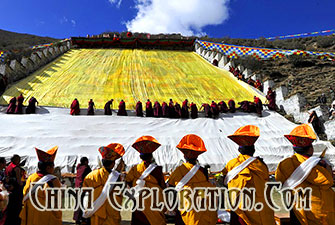
Ganden Monastery is located on Wangbur Mountain , on the southern bank of Lhasa River in Tagtse County , 47 kilometers (29 miles) from Lhasa City . It stands at an altitude of 3,800 meters (12,467 feet) above sea level! Ganden Monastery is one of the earliest and largest Buddhist monasteries in Tibet , and stands atop of the six famous temples of Gelugpa - a branch of Tibetan Buddhism. Its significance as a religious, artistic, political and cultural relic led to it being preserved by the National Key Cultural Relic Preservation scheme in 1961, and is now known as being one of the 'Three Great Temples', together with the Sera Monastery and the Drepung Monastery . Every year, one of the grandest of Buddhist activities - Buddha Painting Unfolding Festival - is conducted in the monastery, attracting thousands of visitors and disciples.
Ramoche Monastery is situated in the northwest of Lhasa , covering a total area of 4000 square meters (one acre). This temple is one of the key cultural relic protection sites of the Tibet Autonomous Region as well as a hot attraction in Lhasa . One of the temple's prized artifacts is the life-sized statue of the 12-year-old Sakyamuni. The Wencheng Princess brought it from the capital Chang'an during the Tang Dynasty.
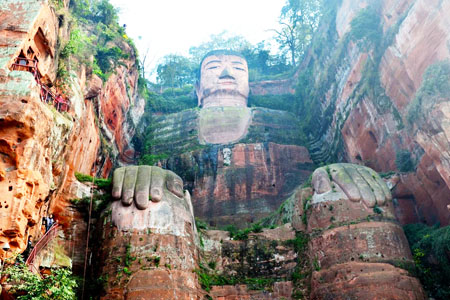
Nietang Buddha, named after Mt. Nietang 40 km (24.85 miles) southwest of Lhasa city, is the biggest stone statue engraved on a cliff in Tibet . Located at the north foot of Nietang Mountain , it is the first attraction to welcome visitors to Lhasa . Almost every passenger wants to get off the bus to get closer to it and take a photo as a souvenir. The Buddha statue is one of Sakyamuni sitting under a bodhi tree to capture evils. The statue is 8 meters (about 26 feet) in width and 9.8 meters (around 32 feet) in height including the base, 1.3 meters (4.27 feet).
It is located in the west city of Shigatse , you can find the gold roof of Tashilunpo Monastery glittering under the sunshine. As one of the Six Big Monasteries of Gelugpa, it was founded in 1447 by Gendun Drup, a nephew of Tsongkhapa (the founder of the Gelukpa (Yellow Hat) sect, the ruling sect of Tibetan Buddhism), one of his foremost disciples, and, retrospectively, the First Dalai Lama.
Shortly after his assumption of power in 1642, the Fifth Dalai Lama declared that his teacher, Losang Chokyi Gyeltsen, then the abbot of Tashilunpo Monastery in Shigatse, was a manifestation of Buddha Amitabha, and the fourth in a line of incarnate lamas starting with Khedrup Je, one of the two chief disciples of Tsongkhapa. Since the abbot of Tashilunpo was already referred to by the title 'Panchen' (Great Scholar), these incarnate lamas were called the Panchen Lamas.
Located in the quiet piedmont area of the Shannan Region, the Samye Monastery is the first temple to be built in Tibet and the first complete with the three Buddhist jewels of Buddha, Dharma and Sangha during the 770's under the patronage of King Trisong Detsen, with the work being directed by Padmasambhava and Shantarakshita, the two Indian masters that the king had invited to Tibet. With these unique features, this splendid temple has become an attraction for visitors from near and far.
Built in the 15th century, Kumbu Monastery is located in Gyangze. It is a monastery that embraces all sects of Buddhism, which is rare in Tibet . The 11-story tower is immense in proportion and has 108 doors, 77 Buddhist shrines and scripture halls.
Sakya Monastery is well known as the "Second Dunhuang", also the first Sakyapa sect of Tibetan Buddhism created by its initiator Khon Konchog Gyalpo in 1073. Sakyapa grew and once ruled Tibet and lived there. The monastery located in Sakya Country, 130 kilometers (80 miles) southwest of Shigatse.
Labuleng lamasery ( or Labrang Monastery ) of Xiahe is in the county town, built in 1710. It’s one of the six most important leading lamaseries of the Yellow Hat Buddhist sect in China , largest around Gansu , Qinghai and Sichuan . It is the greatest lamasery institute with the richest collection of Buddhism scripture.
Tar Monastery is located in the southwest of Lushar Township , Huangzhong County 25 km from Xining , Capital of Qinghai. It was originally built in the 39th year of Jiajing Rein of the Ming Dynasty. The monastery was firstly built with a grand silver stupa and then was enlarged into a scale of a monastery which was accordingly named Tar Monastery, i.e. a monastery with a stupa. It is one of the six greatest monasteries of the Tibetan Buddhism sect called Gelug.
Tar Monastery lies in a mountain cove and is an integrated architectural complex featuring both ancient Chinese and Tibetan style. With its creative and peculiar lay-out, the whole monastery is worth of appreciation for its decoration in delicate parts. The Chinese-Tibetan architectures are so artistically and harmoniously combined that it is not exaggerated to say that every building is of artwork. The essence of Tar monastery is the famous "Three Wonders of Art": butter sculpture, fresco and embroidery.
Related Tours