Potala Palace :
The Potala Palace, of course is a must. Its gold roofs are visible all over Lhasa, but most notably from the roof of the Jokhang. It's easy to see why the first Western visitors to Tibet were utterly enchanted with Lhasa. The sense of achievement at having finally attained this remote city, even by airplane, is still very real. Lhasa sits in a huge crater formed by mountains surrounding it on all sides. In the middle sits the Potala, itself atop its own sizable hill. In front of it spreads the city and the Kyichu river. Behind it a veritable tapestry of fields and flowers spreads back to the mountains. A more picturesque scene could scarcely be imagined. The Potala is the official residence of the Dalai Lama, Buddhism's highest ranking priest.
He is believed to be both a living god and an incarnation of all previous Dalai Lamas. Construction of the Potala Palace was begun by the 5th Dalai Lama, but it was not completed by the time of his death, in 1682. His regent concealed his death whilst the new Dalai was found [there is an elaborate process involved in locating the new Dalai upon the death of the previous incarnation].The Potala contains treasures unimaginable, although it is unfortunate that very little of it is open to the public today. The Tomb of the Fifth Dalai Lama is within the Potala. It is three storeys high, and made of 3,700kg of gold. A multi-tiered model of a palace resembling a wedding cake, and made of over a quarter of a million pearls, is staggering to behold.
Barkhor, a circular street at the center of Old Lhasa, is the oldest street in a very traditional city in Tibet. It is a place where Tibetan culture, economy, religion and arts assemble and a place to which a visit must be paid. Barkhor is the road which pilgrims tramped out around Jokhang Temple through centuries. Buddhist pilgrims walk or progress by body-lengths along the street clockwise every day into deep night. Most of Lhasa's floating population is comprised of these pilgrims. The pilgrims walk outside four columns on which colorful scripture streamers are hung, a custom which began in the Tubo period (633-877) as a way to show respect.
The Norbulingka is the Summer Palace of the Dalai Lamas and while truly run down, this garden still deserves a visit both for its historical and cultural significance. This area is especially interesting on festival days with lots to see. The park was established by the 7th Dalai Lama in 1755. More than just a simple summer retreat, this is the headquarters from which the Dalai Lamas ruled Tibet during the summer months. As successive Dalai Lamas all used the Summer Palace for this purpose, the procession from the Potala to Norbulingka became a grand affair and a festive occasion of the Lhasa calendar. In 1959, the current Dalai Lama (the 14th) made his escape from the Summer Palace disguised as a Tibetan soldier.
Tibetan uprisings followed as the people of Lhasa swelled up to protect the Summer Palace and their spiritual leader, and the subsequent Chinese shelling of the area damaged all the buildings of the Norbulingka. Of special interest is the New Summer Palace, built by the 14th Dalai Lama and located in the center of the Norbulingka. This Palace is filled with interesting murals and is definitely the highlight of the Norbulingka.
Tibet Museum :
The Tibet Museum is located in the southeast corner of Norbu Lingka, Lhasa city. It covers an area of 23,508 square meters (5.8 acres) including the exhibition area of 10,451 square meters (2.6 acres). The museum is equipped with modern facilities to ensure quality service for visitors and safety and efficient administration of the museum itself. Here exhibits are introduced in Japanese, English, Tibetan, and Chinese, in order to accommodate visitors from all over the world.
The Tibet Museum houses a rich collection of prehistoric cultural relics including Buddha statues in different postures, imperial jade seals, gold albums, gifts granted by emperors, colorful tangkas, and various printed Sanskrit and Tibetan scriptures. Visitors can also see variety of folk art such as unique Tibetan handicrafts, costumes, jewelry, and adornments made of gold, silver, and jade, as well as fine Chinese pottery.
Mentsekhang ( Tibetan Traditional Hospital):
Originally built in 1916, Mentsekhang (also called 'Tibetan Medical and Astrological Institute' at that time) was the place of research for Tibetan medicine and calendar calculations for the former Tibetan local government. After a large expansion in 1980, Mentsekhang became the center for the treatment, training, research and production of Tibetan medicine. Covering an area of more than 40,000 sq meters (about 10 acres) and with a staff of 450, Mentsekhang is also the biggest Tibetan traditional hospital in Tibet.
Lhasa Carpet Factory:
Situated to the west of Tibet University Lhasa Carpet Factory is one of the remarkable enterprises in Tibet Autonomous Region, mainly producing traditional Tibetan Carpet. Hundreds of experienced weavers using old-styled vertical looms weave carpets. All the carpets here are hand-made in different sizes, styles, and patterns. Some are elegant, and some are colorful; they can be used as floor covering or hung on the wall as a beautiful picture.
Every item is unique. The factory has developed into the biggest and the best in Tibet Autonomous Region with annual output of 30,000 miles of carpet. Tibetan Carpets, Persian Carpets and Oriental Artistic Carpets are reputed to be the best in the world. The designs of Tibetan carpets embody a flavor of the religions, culture, economy and people and the aesthetic of the patterns are always pleasing. Tibetan Carpets are always a hot seller both home and abroad. A Tibetan Carpet is an ideal purchase as a wonderful reminder of a trip to Tibet.
Yumbulagang, also called“palace of mother and son”in Tibetan dialect, is the first palace ever built in Tibet. It has a history of over 2,000 years. According to the history it was first built for Nyatri Tsanpo, the first Tibetan King. Later it became the summer palace of Songtsan Gampo and Princess Wencheng.
It is the biggest lake throughout Tibet. Meanwhile, it is the highest altitude saltwater lake in the world. The water here is a storybook crystal-clear blue. Clear skies join the surface of the lake in the distance, creating an integrated, scenic vista. Soul of every visitor who has ever been here seems to be cleansed by the pure lake water. Besides the beautiful scenery in Namtso, it is also a famous sacred Buddhist place. There is a Zhaxi Temple in Zhaxi by land. In every Tibetan year of sheep, thousands of Buddhism adherents will come here to worship. As a rule, they will walk clockwise along the Namtso Lake.In order to receive the blessing of the gods.
Mountain Everest: Mount Everest is situated at the edge of the Tibetan Plateau (Qing Zang Gaoyuan), on the border between Nepal and Tibet. The mountain was named for Sir George Everest, a British military engineer who served as surveyor general of India from 1829 to 1843, during which time the peak was surveyed. Everest was the first person to record the location and height of the mountain, then known as Peak XV. Most Nepali people refer to the mountain as Sagarmatha, meaning "Forehead in the Sky." Speakers of Tibetan languages, including the Sherpa people of northern Nepal, refer to the mountain as Chomolungma, Tibetan for "Goddess Mother of the World." In 1954, the height of Mount Everest was determined as 8848 m (29,028 ft)as the highest mountain in the world.
Located in the far west of Tibet , Kailash is above 6638 sea level and is the main peak of the Gangdise Mountains. More than 250 glaciers around the peak make it the sources of the Indus, Ganges and Yarlung Zangbo Rivers. Mt. Kailash has the unique distinction of being the world's most venerated holy place at the same time that it is the least visited. The supremely sacred site of four religions and billions of people, Kailash is seen by no more than a few thousand pilgrims each year. This curious fact is explained by the mountain's remote location in far western Tibet. No planes, trains or buses journey anywhere near the region and even with rugged over-land vehicles the journey still requires weeks of difficult, often dangerous travel. The weather, always cold, can be unexpectedly treacherous and pilgrims must carry all the supplies they will need for the entire journey. Kangrinboqe Peak is the holy mountain in Tibet and attracts flocks of pilgrims from other parts of the country, India and Nepalto pay their respects to the Buddha. Also it is one of the pilgrimage centers of Tibet Buddhism, Hinduism and the Bon.
One of the three sacred lakes in Tibet, Lake Mapam Yumco is a place respected by the Tibetan people, Lake Mapam Yumco is 4,587 meters above sea level. The lake covers an area of 412 square kilometers and is 77 meters deep. On the slope of the mountain by the lake stands the Jiniao Monastery, a best place to overlook the lake.
Guge Kingdom: The Guge Kingdom is a wonder of Ngari. In the mid-nine century, the Tubo imperial court came to and end .The offspring of the King Namdam established their own kingdoms and Gyede Nyimagong became the king of Ngari. The second son of his three sons occupied Zarang and established the Guge Kingdom. In the main ruins of the Guge Kingdom in Zarang, the destroyed city walls and the natural earthen forests exist harmoniously. More than 400 houses and 800 caves scatter on the 300-meter-high mountain slope. As the capital of the Guge Kingdom, the Zarang Ruins cover an area of 720,000 square meters. It is the second largest building complex in Tibet next to the Potala Palace.
Gannan :
Gannan Tibetan Autonomous prefecture is situated at the east edge of Qinghai-Tibetan Plateau. The wonderful scenery there are vast expense of prairie, dense forest , grotesque stone forest and highland lakes. A journey to Gannan is the next best thing to a trip to Tibet, but far more easily accessible.
Travelers and pilgrims alike come here to visit the Labuleng Lamasery of Xiahe, Langmusi monastery of Luqu, Chanding and Gongba Monasteries of Zhuoni. It is a mellow, slightly backward area, which beautiful surroundings everywhere. Southward from here lies the best way to Jiuzhaigou of Sichuan.
In 1939, American novelist James Hilton wrote a book named Lost Horizon, in which he described a paradise-like and peaceful land where there are snow-mountains and deep valleys, brilliant temples and halls, green forests and clear lakes, a crowds of oxen and sheep on the wide grasslands. He named the place Shangri La. What a coincidence it is that there is such a place in Yunnan Province of China. That is Diqing. Moreover, there is a word pronounced Shangri La by local Tibetan people who live in Zhongdian of Diqing that means "moon and sun in heart". Shangri La is an ideal place to spend all their life. May Diqing be Shangri La that all people in the world are expecting to find.
Qinghai Lake
Qinghai Lake is the largest saltwater lake in China with an area of more than 4,500 square kilometers. Vast and green, Qinghai Lake embeds itself amid high mountains and plains like a huge emerald, making up of a spectacular and fascinating scene. Qinghai Lake takes on different view in the four seasons. In summer and autumn, the water and the sky share the same blue, resembling a big pond of clear palms with gentle waves; in winter, the frozen lake is dressed up in white like a tremendous treasured mirror. It shines in the sunshine and dazzles your eyes.
The Sanjiangyuan is long-time reputed the "Water Tower of China± or the "Water Tower of the Asia ". It is hard to discover another place gathering so many mountains and rivers around like the Sanjiangyuan. There may not be such another three rivers that have their origins joined so closely. Undoubtedly, this is the mystic glamour of the Sanjiangyuan. The Sanjiangyuan lies as a large area in the south of Qinghai. The special ecology there creates the world's largest and highest wetland sight. Featuring uncounted rivers, lakes and swamps surrounded, the snow-capped mountains and glaciers show divine verve. Being a paradise for wildlife, the Sanjiangyuan gestates large varieties of flora and fauna. It is regarded as a gene bank of rare plateau species.
Qinghai Kekexili Nature Reserve Park :
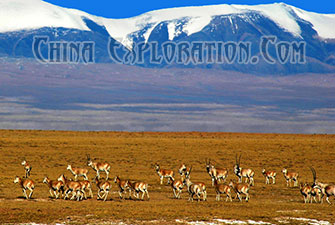
Qinghai Kekexili Nature Reserve Park is located in the joint border of Zhiduo County and Qumalai County with 4,500,000 hectares. Its main protection targets are the unique wild plants and animals in Qinghai-Tibet Plateau and their living environments. In the zone, water systems from Yangtze River converge with water system in the lake; There are inner water systems which is around lakes in west and north,in which there are many lakes.
The main vegetation type are highlands plain and highlands meadow. Original biogeocenose is complete. There are 202 kinds of first class plants, including 84 kinds of own types in Qinghai-Tibet plateau. The zone is the place for rare animals’ inhabiting and multiplying in Qinghai-Tibet Plateau. There are 16 kinds of mammals,30 kinds of birds, including 18 kinds of own animals in Qinghai-Tibet Plateau.
Related Tours