China Exploration
  • China Exploration
  • 86-28-86270775
  • info@chinaexploration.com
  • Tour Code Search
  • HOME
  • China Tours
    • Top 10 China Tours
        Top 10 China Tours
    • Classic China Tours
        Classic China Tours
    • Yangtze Cruise Tour
        Yangtze Cruise Routes

        Yangtze Cruise Routes

        Yangtze Cruise Calendar

        Yangtze Cruise Calendar

    • Join-in Group Tours
        Join-in Group Tours
    • Short Stay Tours
        144 hours VISA free tours

        144 hours VISA free tours

        Less than 7 days tours

        Less than 7 days tours

    • Family Tours
        Family Tours
  • Adventure Tours
    • Overland Off-road Tours
        Overland Off-road Tours
    • Culture & Folklore Tours
        Culture & Folklore Tours
    • Wildlife Exploration Tours
        Wildlife Exploration Tours
    • Trekking & Hiking Tours
        Trekking & Hiking Tours
    • Eco-Tour
        Eco-Tour
    • M.I.C.E. & Event
        M.I.C.E. & Event
    • School and Education Tours
        School and Education Tours
  • DESTINATIONS
      BeijingBeihaiChengduChongqingChangshaChaozhouDaliDalianDunhuangDatongEnshiFuzhouGuilinGuiyangGuangzhouHaerbinHangzhouHohhotHulun BuirHongKongHuangshanJilinJiangxiJinanJinggangshanJiuzhaigouKashgarKaifengKailiKunmingLanzhouLijiangLuoyangNanchangNanjingPutuoshanPingyaoQinghaiQingdaoQinhuangdaoSanyaShanghaiShenyangShandongSuzhouShenzhenShangrilaTibetTianshuiTianjinTaiyuanUrumqiWuyishanWutaishanWudangshanWuhanXiamenXishuangbannaXi'anXiningXinjiangXingyiYinchuanYichangYunnanZhangjiajieZhanjiangZhangye Explore All Destinations>>
  • Customized your trip
  • TRAVEL GUIDE
    • Travel to China
    • China Visa and Permit
    • Chinese Attractions
    • Chinese Culture
    • China Nature Reserve
    • China City Guide
    • China Maps
    • China Travel News
    • China Hotel
    • FAQS
  • About Us
    • Contact Us
    • Our Team
    • Our Glory
    • Olympic Torch Bearer
    • Feedback
    • Photo Album
    • Travel Story
    • Travel Video
    • Teams and Condition
    • Insurance Policy
    • Site Map
  • China Tours
  • Top 10 China Tours
  • Classic China Tours
  • Join-in Group Tours
  • Short Stay Tours
  • Family Tours
  • Adventure Tours
  • Overland Off-road Tours
  • Culture & Folklore Tours
  • Wildlife Exploration Tours
  • Trekking & Hiking Tours
  • Eco-Tour
  • M.I.C.E. & Event
  • School and Education Tours
  • DESTINATIONS
  • Beijing Tours
  • Beihai Tours
  • Chengdu Tours
  • Chongqing Tours
  • Changsha Tours
  • Chaozhou Tours
  • Dali Tours
  • Dalian Tours
  • Dunhuang Tours
  • Datong Tours
  • Enshi Tours
  • Fuzhou Tours
  • Guilin Tours
  • Guiyang Tours
  • Guangzhou Tours
  • Haerbin Tours
  • Hangzhou Tours
  • Hohhot Tours
  • Hulun Buir Tours
  • HongKong Tours
  • TRAVEL GUIDE
  • Travel to China
  • China Visa and Permit
  • Chinese Attractions
  • Chinese Culture
  • China Nature Reserve
  • China City Guide
  • China Maps
  • China Travel News
  • Hotel Booking
  • FAQS
  • About Us
  • Contact Us
  • Our Team
  • Our Glory
  • Olympic Torch Bearer
  • Feedback
  • Photo Album
  • Travel Story
  • Travel Video
  • Terms And Condition
  • Insurance Policy
  • sitemap
Home > TRAVEL GUIDE > China Attractions > Xinjiang Attractions
Abakh Khoja Tomb
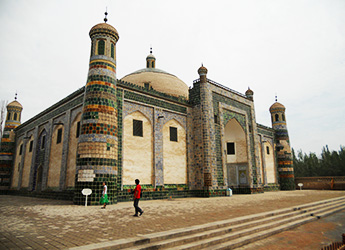
Abakh Khoja Tomb blue glazed architecture in Kashgar XinjiangLocated in Korgan Village, about 5 kilometers northeast of Kashgar City, the Abakh Khoja Tomb (阿巴霍加麻札墓) is one of the most famous Islamic architectural complexes in Xinjiang. Built in 1640, the tomb is regarded as one of the largest and most important Khoja mausoleums (mazar) in the region, representing the religious traditions, history, and artistic achievements of the Uyghur people.
The name “Khoja” refers to descendants of the Prophet Muhammad, and the tomb complex is closely connected with the influential Khoja family, who played an important role in the religious and political history of Kashgar.
 
History of Abakh Khoja Tomb
Originally, the site was known as Yusup Khoja Tomb, named after Haji Muhammad Yusup Khoja, a respected Islamic missionary from Central Asia who arrived in Kashgar during the mid-17th century.
Due to political conflicts, Yusup Khoja later traveled to Hami (Kumul), where he married the daughter of a local nobleman, Mirsayid Jalil. Their son, Abakh Khoja, was born there in 1621.
Later, Yusup Khoja and his family returned to Kashgar, where he gained local support from followers, including a wealthy resident of Korgan Village who donated orchards, gardens, houses, and land. With this support, Yusup Khoja established religious facilities and began building the foundation of what would become the famous tomb complex.
In 1640, Yusup Khoja died while returning from Yarkand and was buried here by his son. The tomb was originally called Yusup Khoja Mazar.
After his father’s death, Abakh Khoja continued his father’s religious work. He became one of the most influential Islamic leaders in Kashgar and played a major role in regional religious affairs. After his death in 1693, he was also buried at the same site.
Because Abakh Khoja became more famous than his father due to his religious and political influence, the tomb gradually became known as Abakh Khoja Tomb.
 
The Legend of Xiangfei (Fragrant Concubine)
The Abakh Khoja Tomb is also famous because of its connection with the legendary Xiangfei (Fragrant Concubine), known in Uyghur as Iparhan.
According to local legends, Emperor Qianlong Emperor once dreamed of a beautiful woman from Kashgar who came to him from the western regions. Later, his officials traveled to Kashgar and found a young Uyghur woman whose beauty matched the emperor’s dream.
The woman was said to have a natural fragrance, so she became known as Xiangfei, meaning “Fragrant Concubine.”
Historical records suggest that Xiangfei was actually a Uyghur woman named Iparhan (1735–1785), a descendant of the Abakh Khoja family. After members of her family assisted Qing forces during conflicts in Xinjiang, she was brought to Beijing and entered the imperial court.
According to tradition, after her death, her remains were transported back to Kashgar and buried in the Abakh Khoja Tomb complex. The journey was said to have taken several years and involved many people, becoming an important part of local folklore.
 
Architecture of Abakh Khoja Tomb
The entire tomb complex covers approximately 48,000 square meters and includes:
* Entrance gate tower
* Ablution pool
* Small daily mosque
* Main mausoleum
* Religious teaching rooms
* Jame Mosque (Friday Mosque)
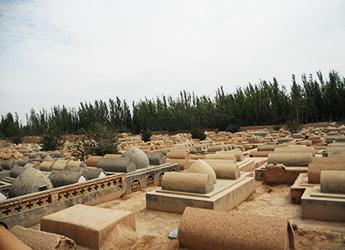
* Large public cemetery
The main mausoleum is a magnificent example of Central Asian Islamic architecture. The building features:
* Blue glazed ceramic tiles
* Large dome-style structure
* Elegant decorative patterns
* Traditional Uyghur architectural elements
The original craftsmanship of the glazed tile decoration is considered highly valuable, as many traditional techniques are no longer practiced today.
 
Inside the Mausoleum
The tomb complex contains the burial sites of several generations of the Khoja family. Historically, 72 members from five generations were buried here.
The main blue-and-green decorated tomb belongs to Abakh Khoja and his family. The smaller tomb traditionally associated with Xiangfei is decorated separately.
Visitors can also see gardens with flowers, especially roses, which provide a peaceful atmosphere and popular photography spots.
 
Uyghur Burial Traditions
The Abakh Khoja Tomb also provides insight into traditional Uyghur Islamic burial customs.
According to local traditions:
1. After a person passes away, the body is cleaned according to Islamic customs.
2. The body is wrapped in white cloth.
3. It is taken to a nearby mosque for prayers.
4. Male relatives and community members carry the body to the cemetery.
5. The body is buried underground beneath the tomb structure.
Uyghur tombs are often shaped like a cradle, symbolizing the connection between birth and death. Just as a baby is placed in a cradle at the beginning of life, a person returns to a similar symbolic resting place after death.
 
Visiting Abakh Khoja Tomb
Today, Abakh Khoja Tomb is one of Kashgar’s most important cultural attractions. Visitors can experience:
* Islamic architecture of Xinjiang
* Uyghur religious traditions
* Silk Road history
* Local legends and folklore
* Traditional gardens and craftsmanship
With its rich history, beautiful architecture, and connection to the famous Xiangfei legend, Abakh Khoja Tomb offers a deeper understanding of Kashgar’s multicultural heritage.


More Attractions

  • Urumqi Travel Guide
    Urumqi Travel Guide
    Urumqi travel guide is to explore Urumqi, the capital of Xinjiang. Discover Tianchi Lake, X......
  • Turpan Travel Guide
    Turpan Travel Guide
    Turpan travel guide is to explore Turpan, Xinjiang’s famous Silk Road oasis. Discover Jia......
  • Tianchi Heaven Lake
    Tianchi Heaven Lake
    Discover Heaven Lake of Tianshan (Tianchi Lake) near Urumqi, a stunning alpine lake surroun......
  • Red Hill Park
    Red Hill Park
    Visit Red Hill Park in Urumqi, Xinjiang. Enjoy panoramic city views, Tianshan mountain scen......

Recommended Tours

1 Day Chengdu Giant Panda and Leshan Buddha Day Trip

Explore Chengdu Panda Base and Leshan Giant Buddha in one day, and enjoy a traditional Xiba tofu banquet and discover Sichuan’s famous creature and Buddhist heritage.......

1 Day Best Chengdu Tours of Sanxingdui and Giant Panda Garden

Explore Chengdu’s highlights in one day with a visit to the Giant Panda Base and Sanxingdui Museum. See adorable pandas and discover the mysterious 3,000-year-old Shu civilization with an expert loca......

1 Day Chengdu Harmoney Tours of Mt Qingchengshan and Dujiangyan Dam

Explore Mount Qingcheng and Dujiangyan near Chengdu, discovering Taoist culture, mountain scenery and a 2,000-year-old ancient irrigation system.......

2 Days Leshan Giant Buddha and Emei Mountain Tours

Classic two days tours to west Chengdu, where Leshan Giant Buddha and Mt Emeishan are both world class top tour destinations, and also visit a local old town. ......

3 Days Chengdu Emeishan and Leshan Giant Buddha Tour

Explore the best of Chengdu and Sichuan on this 3-day private tour. Visit Chengdu Panda Base, Kuanzhai Alley, Wangjianglou Bamboo Park, Leshan Giant Buddha, Luocheng Ancient Town, and Mount Emei with a......

3 Days Three Kingdoms Tour in North Chengdu

Explore Sichuan’s ancient history and culture on a 3-day private tour from Chengdu. Visit the Giant Panda Base, Sanxingdui Museum, Jianmen Pass, Zhaohua Ancient Town, and Langzhong Ancient Town to di......

Popular China Packages
  • Top 10 China Tours
  • Yangtze Cruise Tours
  • China Short Trips
  • Tibet Tours
  • Sichuan Tours
  • Yunnan Tour
  • Guilin Tour
  • Xiamen Tours
Adventure Tours
  • Overland Off-road Tours
  • Culture & Folklore Tours
  • Wildlife Exploration Tours
  • Trekking & Hiking Tours
  • Eco-Tour
  • M.I.C.E. & Event
  • School and Education Tours
China Travel Guide
  • Travel to China
  • China Visa and Permit
  • China Attractions
  • Chinese culture
  • China Nature Reserves
  • City Guide
  • China Maps
  • China Travel News
  • FAQS
Follow Us
Keep me updated
  • Stay up-to-date with the latest news direct to your inbox.

Address: 35th, Yangguang Business Center, Jinjiang District, Chengdu, Zip610065, China
About us | Contact us | Teams and Condition | Customer Center | Site Map
TEL: 028-86270775 E-mail: info@chinaexploration.com
Working hours:9:00AM-6:00PM(GMT+8)),Copyright(2003-2026) 蜀ICP05000963号 China Exploration Tour

  • Email: info@chinaexploration.com
  • Telephone: 86-28-86270775