The traditional story of Confucianism often begins with Confucius, whose Chinese name was Kong Qiu (551–479 BCE). Yet the earliest evidence suggests that Confucius did not regard himself as the founder of a new school of thought. Rather, he saw himself as a transmitter of an earlier tradition, seeking to revive the values, institutions, and rituals of an idealized ancient past.
Confucius was born in the state of Lu and served in a minor government position, where he became familiar with the rituals and institutions governing political and family life. He believed that society could be restored to order by reviving proper ritual practices and cultivating moral character. Such a transformation, in his view, required the active support of responsible rulers.
The ideal ruler was represented by legendary sage-kings such as Yao and Shun, as well as the Duke of Zhou, who was traditionally regarded as an exemplary adviser to the early Zhou rulers. Rather than ruling primarily through punishment and force, an ideal ruler influences people through moral example, a form of ethical persuasion known as de (德), or moral virtue.
Corresponding to the virtues of the ruler are qualities that individuals should cultivate, including benevolence toward others, righteousness, loyalty, diligence, and a strong sense of moral responsibility. Confucius believed that personal morality was essential to social harmony, but moral ideals alone were not sufficient. Society also required a well-developed system of li (礼), usually translated as “ritual,” “rites,” or “propriety.”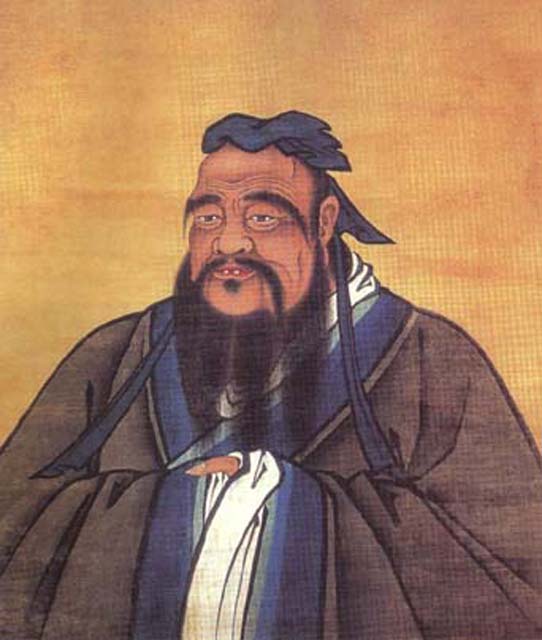
The Importance of Li
The concept of li has several related meanings. It can refer to formal rituals and ceremonies, but it can also mean proper conduct—the ability to behave appropriately according to one's role and circumstances.
Different people were expected to observe different forms of ritual depending on their age, social position, gender, family relationship, and particular situation. In family ceremonies, for example, mourning rituals varied according to one's relationship with the deceased. In diplomatic affairs, the clothing, gifts, and ceremonies appropriate for an envoy depended upon the envoy's rank. Religious sacrifices were similarly regulated, with different social groups performing prescribed offerings to particular categories of deities.
For Confucius, therefore, ritual was not merely a collection of ceremonies. It provided a framework through which individuals learned to understand their responsibilities and relationships within society.
Confucius repeatedly presented himself as one who “transmits rather than creates.” He sought to preserve and communicate the wisdom of the past rather than claim to have invented a new philosophy. In doing so, however, he transmitted not only ethical ideals and rituals but also the hierarchical social order associated with the ancient tradition.
Mencius and Xunzi
The idea of Confucius as the founder of a distinct philosophical tradition developed more clearly after his death. Two of the most influential thinkers associated with this tradition were Mencius (Mengzi, c. 371–289 BCE) and Xunzi (c. 310–235 BCE).
Mencius regarded himself as continuing the teachings and ideals associated with Confucius. He emphasized the innate moral tendencies of human beings and argued that people could develop their natural capacity for goodness through continuous moral cultivation. In his view, an individual could gradually approach the ideal of the sage by nurturing these positive tendencies.
Xunzi shared the goal of creating morally cultivated individuals but offered a very different explanation of human nature. He believed that people were naturally inclined toward selfish desires and that civilization required these impulses to be restrained. Education, social institutions, and ritual were therefore essential tools for transforming human behavior and creating an orderly society.
These differing approaches—Mencius's emphasis on cultivating innate goodness and Xunzi's emphasis on education, discipline, and ritual—became important strands within the later Confucian tradition.
Confucianism under the Han Dynasty
It was not until the Han Dynasty (202 BCE–220 CE) that Confucian ideas became firmly associated with state ideology and education. The development of what we now call “Confucianism” was a gradual and complex process rather than a single event.
In 136 BCE, the Han government established a system of official scholarship centered on the classical texts studied by Confucian scholars. The Five Classics (Wujing) became the foundation of the state educational system:
- Classic of Poetry (Shijing)
- Classic of History (Shujing)
- Classic of Changes (Yijing)
- Record of Rites (Liji)
- Spring and Autumn Annals (Chunqiu)
Interestingly, most of these texts predated Confucius himself, although later tradition closely associated them with his intellectual legacy. In this context, “Confucianism” meant not simply the philosophy of Confucius but also a curriculum of classical learning officially supported by the imperial government.
Confucianism also became associated with a state-sponsored ritual system. Government authorities established shrines and temples dedicated to Confucius and incorporated ceremonies honoring him into the official religious and political structure of the empire.
Dong Zhongshu and the Development of Confucian Thought
Another important stage in the development of Confucianism was the work of Dong Zhongshu, a major Han Dynasty thinker. Dong combined ideas associated with Confucius with cosmological theories that had developed in the centuries after Confucius's death.
His thought incorporated concepts such as yin and yang, the interaction between Heaven and humanity, and other elements of contemporary Chinese cosmology. Rather than simply preserving an unchanged philosophy inherited from Confucius, Dong Zhongshu helped create a broader intellectual system that placed Confucian ideals within the political and cosmological framework of the Han Dynasty.
Thus, the term “Confucianism” has referred to different things at different points in Chinese history: a body of classical texts, a system of moral and political thought, a program of education, a tradition of ritual practice, and eventually a state-supported cultural and intellectual system.
Confucius himself may have described his role as that of a transmitter rather than a creator. Nevertheless, the tradition associated with his name evolved substantially after his death and became one of the most influential intellectual forces in Chinese history, shaping Chinese education, government, family relationships, ethics, literature, and social values for more than two thousand years.