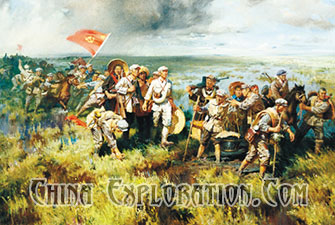
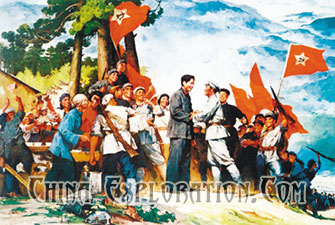
The Long March was a series of strategic military retreats undertaken by the Red Army of the Chinese Communist Party (CPC), the predecessor of the People's Liberation Army, in the 1930s. The Communist forces withdrew from their bases in southern China to escape encirclement and pursuit by the armies of the Kuomintang (KMT), or Chinese Nationalist Party.
Strictly speaking, there was not a single Long March. Several Communist armies carried out separate retreats from different parts of southern China toward the north and west. The most famous was the march of the First Front Army, which began in Jiangxi Province in October 1934.
At that time, the Communist forces were based in the Jiangxi Soviet, but repeated KMT military campaigns had placed them under increasing pressure. Facing the threat of destruction, the First Front Army broke out of its bases and began a difficult retreat.
The Communist forces initially moved westward and later turned north. Under the eventual leadership of Mao Zedong and Zhou Enlai, the army crossed some of the most challenging terrain in western China, including mountains, rivers, grasslands, and high-altitude regions. The journey eventually brought the surviving forces to Shaanxi, in northwestern China.
The exact length of the route varies according to which units and routes are included, but the best-known route is commonly described as covering roughly 12,500 kilometers (8,000 miles) over about a year. The troops endured extreme weather, difficult terrain, food shortages, disease, and repeated military engagements. Only a fraction of those who initially set out from Jiangxi completed the journey.
The Long March became a defining episode in the history of the Chinese Communist Party. It helped preserve the Communist military forces during a period of severe crisis and eventually brought the revolutionary base to northern China, where it could regroup and expand.
The march also played a decisive role in the rise of Mao Zedong. His military and political leadership during the retreat strengthened his position within the Communist Party. The Zunyi Conference in Guizhou in January 1935, held during the Long March, marked an important turning point in the party's leadership and contributed to Mao's growing influence.
After the Communist forces reached Shaanxi, the Long March was gradually transformed into a powerful symbol of perseverance, sacrifice, and revolutionary determination. In the official history of the People's Republic of China, it occupies a central place in the narrative of the Communist revolution and Mao Zedong's emergence as the party's principal leader.
Related Tours
3 Days Three Kingdoms Tour in North Sichuan
Insight Cultural Exploration in Sichuan of Southwest China
China Festival Tours
China Daoism Sacred Mountain Pilgrim
Chengdu Tours
China Hiking & Trekking Tour
Kham Kingdom Overland Exploration