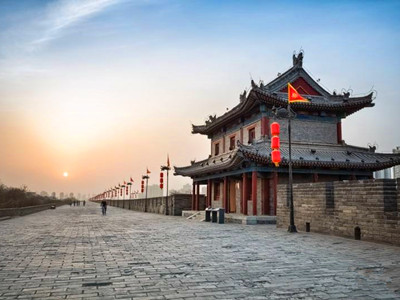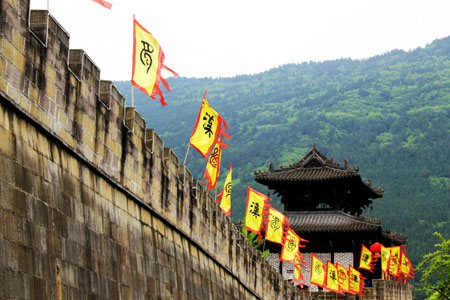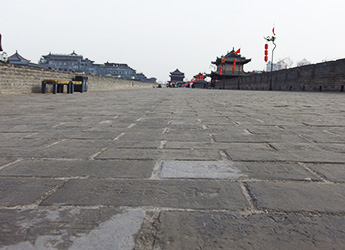
Xi’an Ancient City Wall (西安古城墙) is the most complete and best-preserved ancient city wall in China and one of the most iconic historical landmarks in Xi’an, Shaanxi Province. Surrounding the old city center, this magnificent defensive structure represents the long history of Xi’an as the ancient capital of China.
As one of China’s Four Great Ancient Capitals, Xi’an served as the capital for 13 dynasties, including the Zhou, Qin, Han, Sui, and Tang dynasties. The construction of strong city defenses was therefore essential to protect the political and cultural center of ancient China.
Today, the Xi’an Ancient City Wall is one of the must-visit attractions for travelers exploring the city, offering a unique opportunity to experience ancient Chinese architecture, history, and urban planning.
History of Xi’an Ancient City Wall
The present Xi’an City Wall was built during the Ming Dynasty (1368–1644) under the reign of Emperor Hongwu between 1370 and 1378.
However, it was constructed on the foundations of earlier city walls from the Sui Dynasty (581–618) and Tang Dynasty (618–907), when Xi’an was known as Chang’an and served as the capital of powerful Chinese empires.
With a history of more than 600 years, the Ming Dynasty City Wall remains the most complete ancient city wall in China and an outstanding example of traditional Chinese military architecture.
In 1983, Shaanxi Province launched a large-scale restoration project to preserve the wall and restore many of its original architectural features, including ancient gate towers and surrounding landscapes.
 Structure and Dimensions of Xi’an City Wall
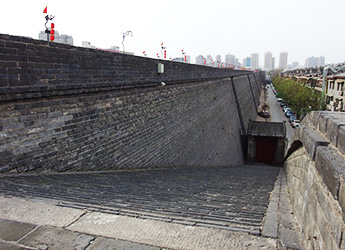
The Xi’an Ancient City Wall forms a complete rectangular defensive system surrounding the old city.
The main measurements include:
* Total circumference: approximately 13.9 kilometers
* Height: about 12 meters
* Width at foundation: about 18 meters
* Width at the top: about 15 meters
The wall is equipped with a complete ancient defense system, including:
* City gates
* Watchtowers
* Corner towers
* Turrets
* Battlements
* Defensive platforms
* Surrounding moat
The combination of these structures demonstrates the advanced military engineering skills of ancient China.
The Four Main Gates of Xi’an City Wall
The ancient city wall has four main gates located in the four directions:
Yongning Gate (South Gate)
The most famous and best-preserved gate, Yongning Gate is often used for cultural performances and ceremonies. It is also a popular place to enjoy the night view of Xi’an.
Changle Gate (East Gate)
Located on the eastern side of the wall, Changle Gate was an important entrance to the ancient city.
Anding Gate (West Gate)
Anding Gate was historically connected with routes leading westward along the Silk Road.
Anyuan Gate (North Gate)
Located on the northern side, Anyuan Gate played an important defensive role in protecting the ancient capital.
Cycling on Xi’an Ancient City Wall
One of the most popular ways to experience the city wall is by bicycle.
Visitors can rent bicycles on the top of the wall and ride around the entire ancient city, enjoying panoramic views of both historic neighborhoods and modern Xi’an.
Cycling along the wall allows travelers to imagine life in ancient China while appreciating the contrast between:
* Ancient defensive architecture
* Traditional city layout
* Modern urban development
The wide surface of the wall makes it one of the best urban cycling routes in China.
Night View of Xi’an City Wall
The Xi’an Ancient City Wall becomes especially beautiful after sunset.
When the towers, gates, and battlements are illuminated, the wall creates a spectacular scene blending ancient architecture with modern city lights.
The surrounding City Wall Park also provides a relaxing environment with:
* Green spaces
* Walking paths
* Cultural performances
* Photography opportunities
The night view of the illuminated city wall is one of the most memorable experiences in Xi’an.
Ancient Defense System of Xi’an
The development of Xi’an’s defensive structures dates back thousands of years.
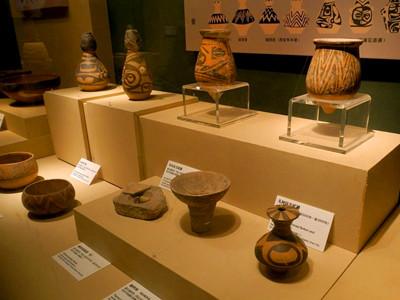
At the Banpo Neolithic Site, archaeologists discovered that ancient inhabitants had already built protective ditches around their settlements to defend against wild animals and possible conflicts.
Over time, these simple defensive measures evolved into increasingly sophisticated systems:
* Protective moats in ancient settlements
* Rammed earth walls during the Sui Dynasty
* Strong brick and stone walls during the Ming Dynasty
The Xi’an Ancient City Wall represents the peak of this long development process.
Why Visit Xi’an Ancient City Wall?
The Xi’an Ancient City Wall is not only a historical monument but also a living cultural landmark where visitors can experience the connection between past and present.
A visit here offers:
* A close look at ancient Chinese military architecture
* Stunning views of Xi’an’s old and modern city
* A unique cycling experience
* Beautiful photography opportunities
For anyone visiting Xi’an, walking or cycling on the Ancient City Wall is one of the best ways to understand the history and spirit of this legendary Chinese capital.