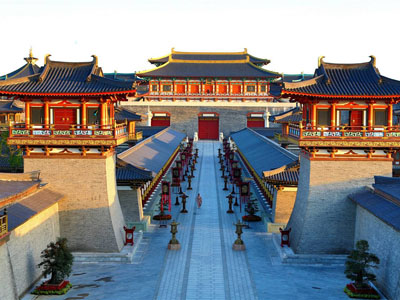
 Wuwei City is an important historical and cultural destination located in the eastern section of the Hexi Corridor in Gansu Province, China. Situated along the ancient Silk Road, Wuwei was once a major economic, political, and cultural center connecting the Central Plains of China with Central Asia and the Western Regions.
As a key gateway on the western Silk Road, Wuwei served as a meeting point where Eastern and Western civilizations exchanged goods, religions, languages, and ideas. Throughout Chinese history, many dynasties established administrative centers here, making Wuwei one of the most important cities in northwest China.
Today, Wuwei is recognized as a National Historical and Cultural City, an important city along the Silk Road Economic Belt, and a central city of the Hexi Corridor. With its rich historical heritage, unique natural landscapes, and numerous cultural attractions, Wuwei has also been named one of China’s Excellent Tourist Cities and is known as the “China Wine City.”
History of Wuwei: An Ancient Silk Road Hub
Wuwei has a history dating back more than 4,000 years. In ancient times, northern ethnic groups such as the Rong, Yuezhi, and Wusun lived and flourished in this region.
During the reign of Emperor Wu of the Han Dynasty, General Huo Qubing led military campaigns in Hexi and defeated the Xiongnu. To commemorate the Han Empire’s military achievements and “martial power,” the city was named Wuwei, meaning “military might.”
During the Sixteen Kingdoms period, the Former Liang, Later Liang, Southern Liang, and Northern Liang regimes all established their capitals in Wuwei. At that time, Buddhism flourished and the city became one of the most important Buddhist cultural centers in northern China.
The famous Tianti Mountain Grottoes, excavated during the Northern Liang Dynasty, became a representative example of early Chinese Buddhist cave art. The Luoshi Temple in Wuwei was also closely associated with the famous Western Regions monk Kumarajiva, who played an important role in translating Buddhist scriptures into Chinese.
During the Tang Dynasty, Wuwei became the location of the Hexi Governor’s Office and an important military base defending the western frontier. The city also served as a significant political and cultural center along the Silk Road.
Top Attractions in Wuwei Gansu
Wuwei is home to numerous historical sites and cultural landmarks, including:
* Xixia Museum
* Wuwei Confucian Temple
* Leitai Han Tomb
* Tianti Mountain Grottoes
* Liangzhou Alliance Memorial Hall
* Ruian Fort
* Other Silk Road heritage sites and ancient cultural attractions
These attractions provide visitors with a deeper understanding of China’s ancient history, Buddhist culture, and Silk Road civilization.
 Xixia Museum: Explore Western Xia Dynasty Culture
Located in front of the Wuwei Confucian Temple, the Xixia Museum is an important museum dedicated to the history and culture of the Western Xia Dynasty (1038–1227 AD).
The museum features a traditional “回”-shaped antique architectural design, covering approximately 3,570 square meters, with an exhibition area of about 1,400 square meters.
Through large-scale relief sculptures, historical images, murals, and background displays, the museum presents the political, economic, military, and cultural achievements of Wuwei during the Western Xia period.
The collection includes many precious cultural relics, such as the national key protected Wooden Pagoda Relic, the national first-class cultural relic Western Xia Woodblock Painting, and the rare Western Xia movable-type Buddhist scriptures.
The museum is an excellent place to explore the mysterious Tangut civilization and understand the important role Wuwei played in Silk Road history.
Wuwei Confucian Temple: The Largest Confucian Temple in Northwest China
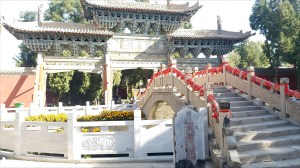
The Wuwei Confucian Temple is located at No.172 Chongwen Street, Liangzhou District, Wuwei City, Gansu Province. Originally built in 1437 during the Ming Dynasty, it was constructed under the supervision of Xu Xi from the Ministry of War.
Covering an area of approximately 30,096 square meters, the temple complex consists of three major sections:
* Wenchang Palace in the east
* Confucius Temple in the center
* Liangzhou Confucian Academy in the west
The three sections are arranged symmetrically along a north-south axis, preserving the traditional courtyard layout of ancient Chinese architecture.
As the largest and best-preserved Confucian temple in northwest China, Wuwei Confucian Temple is an important example for studying the relationship between Hexi traditional architecture, Confucian culture, and Wenchang culture.
The temple contains architectural features from the Ming Dynasty to the Republic of China period. Its exquisite wooden structures, decorative details, and cultural atmosphere reflect the long-standing importance of education and Confucian traditions in Wuwei.
Leitai Han Tomb: Home of China’s Tourism Symbol
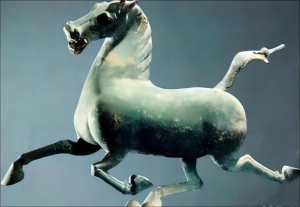
Leitai Han Tomb is one of Wuwei’s most famous archaeological discoveries and the birthplace of the legendary Copper Galloping Horse, also known as the “Horse Stepping on a Flying Swallow,” which became the symbol of Chinese tourism.
Located at No.272 Beiguan Middle Road, Liangzhou District, the tomb dates back to the late Eastern Han Dynasty.
The Leitai Han Tomb is a large brick-and-stone underground burial complex built beneath the Lei Tai platform. Tomb No.1 is a high-level husband-and-wife burial site with a complex structure including an entrance passage, corridor, front chamber, side chambers, middle chamber, and rear chamber.
The tomb features brick carvings, vaulted ceilings, and decorative lotus patterns. Another tomb nearby has a similar design but is smaller and lacks side chambers.
More than 230 cultural relics were discovered here, including bronze, gold, silver, jade, pottery, and thousands of ancient coins. Among them, the most famous artifact is the Copper Galloping Horse, an extraordinary masterpiece of ancient Chinese bronze craftsmanship.
Tianti Mountain Grottoes: The Origin of Chinese Grotto Art
Located in Dingshan Village, Zhangyi Town, about 50 kilometers south of Liangzhou District, Tianti Mountain Grottoes (also known as Liangzhou Grottoes or Giant Buddha Temple) is one of the earliest Buddhist grotto complexes in China.
First excavated during the Northern Liang Dynasty (397–439 AD), the grottoes have a history of more than 1,600 years.
The mountain features steep peaks and rugged paths resembling a hanging ladder, which gave the site its name “Tianti Mountain” (Heavenly Ladder Mountain). Covered with snow throughout much of the year, it was historically listed among the Eight Scenic Views of Ancient Liangzhou as “Tianti Snow.”
The most impressive attraction is the 13th Cave, which contains a giant seated Buddha statue approximately 28 meters high and 10 meters wide. Surrounded by mountains, rivers, and clouds, the Buddha creates a spectacular scene combining natural beauty and Buddhist art.
Tianti Mountain Grottoes is considered a masterpiece of early Chinese grotto art. Its artistic style and construction techniques influenced later Buddhist sites and formed the famous “Liangzhou Model” in the history of Chinese grotto development.
Why Visit Wuwei Gansu?
With its ancient Silk Road heritage, Buddhist treasures, Han Dynasty relics, Western Xia culture, and traditional Chinese architecture, Wuwei offers travelers a unique journey through more than 2,000 years of Chinese history.
For visitors exploring the cultural route of the Hexi Corridor and Silk Road, Wuwei is an essential destination that combines archaeology, history, religion, and breathtaking landscapes.
Wuwei Tour Routes and Packages:
1. Six-day Great Wall & Dunhuang Tour