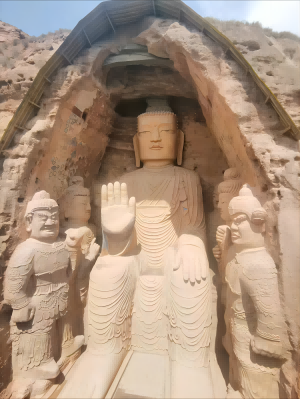
 Tianti Mountain Grottoes, also known as the Liangzhou Grottoes and commonly called the Giant Buddha Temple, is one of the earliest Buddhist grotto complexes in China. Located in Dingshan Village, Zhangye Town, approximately 50 kilometers south of Liangzhou District in Wuwei City, Gansu Province, the grottoes have a history of more than 1,600 years.
First excavated during the Northern Liang Dynasty (397–439 AD) in the Sixteen Kingdoms period of the Eastern Jin Dynasty, Tianti Mountain Grottoes is regarded as an outstanding representative of early Chinese grotto art. Due to its important historical influence on the development of Buddhist cave architecture, it is often praised by historians as “the source of Chinese grottoes and the ancestor of grotto art.”
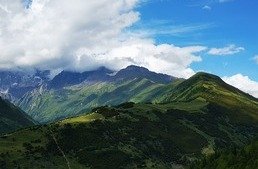
The Tianti Mountain area features towering peaks, steep cliffs, and rugged mountain paths. Because the mountain resembles a hanging ladder leading toward the sky, it was named “Tianti Mountain” (Heavenly Ladder Mountain). Covered with snow throughout much of the year, the scenery of the mountain was historically known as one of the Eight Scenic Views of Ancient Liangzhou — “Tianti Snow.”
The Magnificent Giant Buddha Cave
The most famous attraction of Tianti Mountain Grottoes is the 13th Cave, which houses a spectacular seated Buddha statue. The main Buddha statue is approximately 28 meters high and 10 meters wide, carved directly into the mountain.
The Buddha sits facing the surrounding mountains and water, with the right arm extending outward. The blue river, surrounding peaks, and drifting clouds create a breathtaking landscape where mountains, water, Buddha statues, and clouds blend together.
This unique combination of natural scenery and Buddhist art has made Tianti Mountain Grottoes one of the most famous cultural and tourism destinations in Liangzhou.
A Milestone in the History of Chinese Buddhist Grottoes
The excavation of Tianti Mountain Grottoes began between 412 and 439 AD under the leadership of Juqu Mengxun, ruler of the Northern Liang Dynasty. After its initial construction, the grottoes continued to be expanded, repaired, and restored through later periods, including the Northern Dynasties, Sui, Tang, Song, Western Xia, Ming, and Qing dynasties.
During the Wuliang Period, the flourishing of Buddhism became one of the most important characteristics of Liangzhou culture. The construction of Tianti Mountain Grottoes attracted Buddhist monks and scholars from the Western Regions, who traveled to Liangzhou to preach Buddhist teachings and translate scriptures.
As a result, Tianti Mountain became an important center for the spread of Buddhism and the development of Buddhist art along the ancient Silk Road. Its influence played a significant role in the history of Chinese grotto architecture and the expansion of Buddhist culture throughout China.
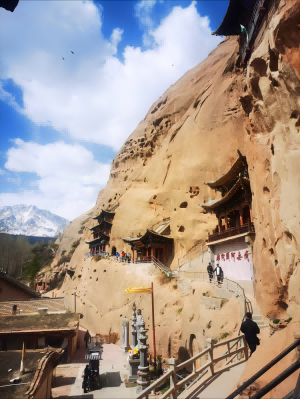 The “Liangzhou Model” of Grotto Art
Tianti Mountain Grottoes is not only one of the earliest Buddhist cave temples in China but also a key example of early Chinese grotto design and artistic development.
During the construction process, generations of highly skilled craftsmen, sculptors, and mural painters were trained here. After the completion of the grottoes, many of these artistic techniques spread to other important Buddhist sites.
With the eastward movement of the Buddhist cultural center, artisans from Liangzhou contributed to the construction and artistic development of famous grottoes such as Yungang Grottoes in Datong and Longmen Grottoes in Luoyang. At the same time, Buddhist culture also spread westward to Dunhuang, promoting the prosperity of the Dunhuang Grottoes and creating a new peak in Hexi Buddhist art.
The artistic style of the famous Great Tang Buddha in Cave 130 of Dunhuang Mogao Grottoes shows similarities with the Giant Buddha of Tianti Mountain, demonstrating the direct influence of Tianti Mountain’s sculpture techniques and architectural style on later grotto art.
Cultural Treasures of Tianti Mountain Grottoes
Today, the visible Giant Buddha Cave mainly reflects artistic achievements from the Tang Dynasty, while some of the most valuable early Northern Liang Dynasty grotto remains are considered national cultural treasures of China.
The large murals painted on the northern and southern walls of the Giant Buddha Cave are especially precious. These murals feature fresh and delicate brushwork, vivid figures, and bright colors, reflecting the high artistic achievements of ancient Chinese Buddhist painting.
With its ancient history, magnificent Buddha sculptures, valuable murals, and important role in the spread of Buddhism, Tianti Mountain Grottoes remains one of the most significant Buddhist heritage sites in Gansu and an essential destination for travelers exploring China’s Silk Road culture.
Tiantishan Mountain and Zhengye Tour Routes:
1. Six-day Great Wall & Dunhuang Tour