 Leitai Han Tomb is one of the most important archaeological discoveries in northwest China and the birthplace of the famous Copper Galloping Horse, also known as the “Horse Stepping on a Flying Swallow”, which has become the official symbol of Chinese tourism.
The tomb is located at No. 272 Beiguan Middle Road, Liangzhou District, Wuwei City, Gansu Province. Dating back to the late Eastern Han Dynasty (25–220 AD), Leitai Han Tomb is believed to be the burial place of Zhang Jun, the governor of Zhangye, who lived approximately between 186 and 219 AD.
The name “Leitai” comes from its historical connection with ancient ceremonies honoring the Thunder God. The tomb was built beneath the Lei Tai platform and represents one of the most significant Han Dynasty burial sites discovered in China.
Architecture and Structure of Leitai Han Tomb
Leitai Han Tomb is a large brick-and-stone underground tomb consisting of two main tombs built beneath the earth platform. Tomb No.1 is a high-ranking husband-and-wife burial site with a sophisticated architectural design.
The tomb faces east and includes a long entrance passage, corridor, front chamber with left and right side chambers, middle chamber with an additional side chamber, and a rear chamber. Inside the tomb are structures resembling a bedroom hall and attached buildings, reflecting the burial customs and architectural concepts of the Eastern Han Dynasty.
Above the tomb entrance is a beautifully carved brick doorway. The entire tomb chamber measures approximately 19.34 meters in length and features brick construction, a vaulted ceiling, and square bricks decorated with large lotus patterns.
Tomb No.2 has a similar design but is smaller in scale and does not contain side chambers.
Precious Cultural Relics Unearthed from Leitai Han Tomb
More than 230 valuable cultural relics were discovered in Leitai Han Tomb, including objects made of gold, silver, bronze, iron, jade, bone, lacquer, stone, and pottery. In addition, more than 30,000 ancient coins were unearthed from the site.
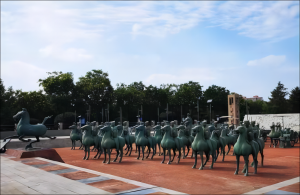
Among the discoveries were 127 bronze artifacts, some of which contain inscriptions. The most remarkable collection is the bronze chariot and horse procession, consisting of 99 bronze figures and horses, which provides important information about transportation, military formations, and ceremonial traditions during the Eastern Han Dynasty.
The most famous and valuable artifact is the extraordinary bronze sculpture known as the Copper Galloping Horse, which represents the highest level of ancient Chinese bronze-casting technology.
 Copper Galloping Horse: The Symbol of Chinese Tourism
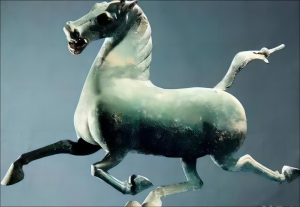
The Copper Galloping Horse, also called the “Horse Stepping on a Flying Swallow”, is the most famous treasure discovered at Leitai Han Tomb. The sculpture is 34.5 centimeters high and 40.5 centimeters long. It depicts a powerful horse galloping forward with one hoof standing on a flying swallow while the other three legs are raised in the air.
The artifact was unearthed in Wuwei, Gansu Province, in October 1969 and is now preserved in the Gansu Provincial Museum.
The sculpture perfectly combines artistic imagination with realistic observation. The horse has a powerful posture, a raised head, flowing tail, and dynamic movement, creating a vivid impression of speed and strength. The flying swallow beneath its hoof turns its head backward and spreads its wings, emphasizing the incredible speed of the horse as if it has surpassed the bird like a shooting star.
Through ingenious artistic design, the creator successfully overcame the contradiction between weight and movement, reality and imagination. The sculpture achieves both visual balance and artistic harmony, creating the unforgettable image of a horse flying through the sky.
Visit Leitai Han Tomb and Discover Ancient Chinese Civilization
Today, Leitai Han Tomb in Wuwei is an important cultural attraction for travelers interested in Chinese history, archaeology, and ancient art. The discovery of the Copper Galloping Horse has made Wuwei an essential destination along the historic Silk Road, offering visitors a unique opportunity to explore the achievements of Han Dynasty civilization and the artistic creativity of ancient China.
Leitai Han Tomb of Wuwei Tour Routes and packages:
1. Six-day Great Wall & Dunhuang Tour