China Exploration - China Adventure Tours and Travel Service
  • China Exploration - China Adventure Tours and Travel Service
  • 86-28-86270775
  • info@chinaexploration.com
  • Tour Code Search
  • HOME
  • China Tours
    • Top 10 China Tours
    • Classic China Tours
    • Yangtze Cruise Tour

        Yangtze Cruise Routes

        Yangtze Cruise Calendar

    • Join-in Group Tours
    • Short Stay Tours

        144 hours VISA free tours

        Less than 7 days tours

    • Family Tours
  • Adventure Tours
    • Overland Off-road Tours
    • Culture & Folklore Tours
    • Wildlife Exploration Tours
    • Trekking & Hiking Tours
    • Eco-Tour
    • M.I.C.E. & Event
    • School and Education Tours
  • DESTINATIONS
      BeijingChengduChongqingDaliDatongGuilinGuiyangHangzhouHongkongHuangshanKunmingLanzhouLhasaLijiangLuoyangPingyaoSanyaShanghaiShangrilaHohhotUrumqiWuhanXiamenXi’anXiningYinchuanZhangjiajie Explore All Destinations>>
  • Customized your trip
  • TRAVEL GUIDE
    • Travel to China
    • China Visa and Permit
    • Chinese Attractions
    • Chinese Culture
    • China Nature Reserve
    • China City Guide
    • China Maps
    • China Travel News
    • Hotel Booking
    • FAQS
  • About Us
    • Contact Us
    • Our Team
    • Our Glory
    • Olympic Torch Bearer
    • Feedback
    • Photo Album
    • Travel Story
    • Travel Video
    • Teams and Condition
    • Insurance Policy
    • Site Map
  • China Tours
  • Top 10 China Tours
  • Classic China Tours
  • Join-in Group Tours
  • Short Stay Tours
  • Family Tours
  • Adventure Tours
  • Overland Off-road Tours
  • Culture & Folklore Tours
  • Wildlife Exploration Tours
  • Trekking & Hiking Tours
  • Eco-Tour
  • M.I.C.E. & Event
  • School and Education Tours
  • Honeymoon Tour
  • DESTINATIONS
  • Beijing Tours
  • Chengdu Tours
  • Chongqing Tours
  • Dali Tours
  • Dalian Tours
  • Datong Tours
  • Guilin Tours
  • Guiyang Tours
  • Guangzhou Tours
  • Haerbin Tours
  • Hangzhou Tours
  • Hohhot Tours
  • HongKong Tours
  • Huangshan Tours
  • Kashgar Tours
  • Kunming Tours
  • Lanzhou Tours
  • Tibet Tours
  • Lijiang Tours
  • Luoyang Tours
  • TRAVEL GUIDE
  • Travel to China
  • China Visa and Permit
  • Chinese Attractions
  • Chinese Culture
  • China Nature Reserve
  • China City Guide
  • China Maps
  • China Travel News
  • Hotel Booking
  • FAQS
  • About Us
  • Contact Us
  • Our Team
  • Our Glory
  • Olympic Torch Bearer
  • Feedback
  • Photo Album
  • Travel Story
  • Terms And Condition
  • Insurance Policy
  • sitemap
Home > TRAVEL GUIDE > China Attractions > Fujian Attractions
Quanzhou Tour
Quanzhou was " the largest port in the East in ancient time", and the starting point of the "Ocean Silk Road", and it was also one of the first 24 famous historical and cultural cities enlisted by the State Council of China. In the 13th century, Marco Polo boarded the ship from Quanzhou port to returned to Italy. He praised Quanzhou as "the city of light". In 2021 AD, Quanzhou was approved to be listed in the World Heritage List as "Quanzhou: The World Ocean Trade Center in Song and Yuan Dynasteries of China".
 
Quanzhou, alias "carp city", "thorn tung city". During the Western Jin Dynasty, there were long time’s chaos of wars and frequant dynasties changing in the Central China, so the large family of the Central China immigrated to south China here. They settled in both sides of the Luoyang River, and Quanzhou. During the Tang Dynasty, Quanzhou developed overseas trade and set up a "Foreign Trade Department",  like today's customs, which specialized the foreign trade of Quanzhou. During the Song and Yuan dynasties, Quanzhou gradually developed into the world's largest port and was renowned in the world by the name of "Citong Port". At that time, the cargo throughput of Quanzhou port was the first in the world, far exceeding the Alexandria Port in Egypt.  Ancient Quanzhou people generally believed in many religions. For a while, a variety of religious statues, temples, churches in Quanzhou everywhere. In addition to Buddhism and Taoism, there are also Arab and Persian merchant faith, including Catholic, Hinduism, Islam, Hinduism, Manichaeism, and so on. Quanzhou has so far retained a large number of historical civilization, its "Nanyin", Liyuan opera, Gaojia opera, puppet opera and so on have been deeply loved by the people, and widely spread.
 
Today's Quanzhou city, connecting Fuzhou in the north, Xiamen in the south and Taiwan Baodao in the east. It is one of the three central cities in Fujian Province. In 2022, Quanzhou's GDP will reach 1210.2 billion yuan, surpassing Xiamen and Fuzhou and ranking first in Fujian.
 
Firstly there was Jinjiang, and then Quanzhou city. In the Western Jin Dynasty, the Jin people moved south to settle down. For missing their hometown, they named the river as Jinjiang. After many historical changes, Jinjiang has become a county-level city under the jurisdiction of the state and the city. Jinjiang County once because of barren land, before the reform and opening up is "difficult to raise one side" of the poor agricultural county. At the beginning of the reform and opening up in the 1980s, Jinjiang people seized the opportunity, started from scratch, stepped on sewing machines, and opened family workshops of shoes and clothing, which quickly sprouted numerous clothing manufacturing industry.
 
Today, Jinjiang has long since become a modern and international metropolis. In 2022, the GDP of Jinjiang reached 320.7 billion yuan, leading the county economy of Fujian province for 29 consecutive years, and ranking among the top 10 in the top 100 counties and cities in China for many years. This narrow county, with only 649 square kilometers and a permanent population of more than 3 million, has 51 listed companies and more than 1,000 enterprises with an annual output value of over 1,000 yuan, and a series of world-renowned sports brands such as Anta, 361 and Xtep have emerged.
 
The Main Attractions of Quanzhou City:
 
Kaiyuan Temple
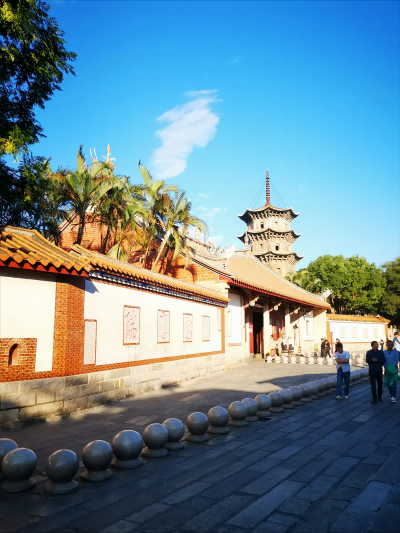
Kaiyuan Temple is located in the West Street, Quanzhou City, Fujian Province, which is the largest Buddhist temple in Fujian Province. The temple was founded in the Tang Dynasty (686 AD). It is said that Huang Shougong, a rich man in Quanzhou in the Tang Dynasty, dreamed of a lotus flower growing from a mulberry tree, so he abandoned the mulberry garden to build a temple. It is the largest and the most prominent official Buddhist temple in Quanzhou. Now the temple is 260 meters long from north to south and 300 meters wide from east to west, and covers an area of 78,000 square meters. Quanzhou Kaiyuan Temple is one of the 22 representative historic sites of Quanzhou that have applied for world Cultural Heritage.
 
Kaiyuan Temple layout, the central axis from the south to the north are: Purple Cloud Screen, mountain gate (Tianwang hall), pavilion, great male hall, Ganlu ring altar, Sutra pavilion. In the east wing, there are Tanyue Temple, Quanzhou Buddhist Museum (Master Hongyi Memorial Hall), and ZhunTemple; in the west wing, there are nursing homes, merit halls and water temples, and the east and west sides of the pavilion, commonly known as the east and west towers.
 
East Tower
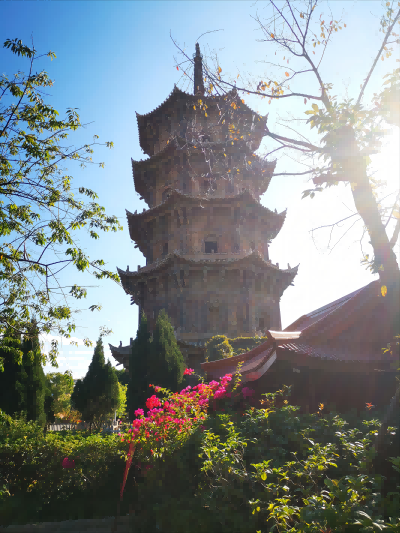
East for the "town pagoda", was built in the sixth year of the Tang Dynasty (865 AD), by the author built five-story wooden tower, after several destruction and repair, wood for brick, in the Southern Song Dynasty (AD 1227) changed to 20 brick tower. Today's stone pagoda was rebuilt in the Southern Song Dynasty from 1238 to 1250 AD, is 48.24 meters high.
 
The East tower is divided into four parts: corridor, outer wall, inner corridor and octagonal pillar in the tower center. The tower is a frame-type structure. The center of the tower center column straight through each layer, is the support of the whole tower. The eight corners of the core columns on the tower of each floor are equipped with stone beams, which are connected to the 2-meter-thick tower wall and leaning columns. The protective bucket of the top pillar is lifted out of the great arch to narrow the span of the stone beams. The stone beam and the beam support are like a chisel, and the tenon joint, which makes the stress of the tower center and the tower wall form an integration, greatly strengthening the firmness of the tower. The walls of the tower are carved granite, crisscross, with accurate calculation and meticulous construction. In 1997, the East Tower was selected as one of the four most famous towers in China, which can be called the king of stone towers.
 
West Tower
In the west, the "Renshou Pagoda" was first built in the Five Dynasties Liang Dynasty (916 AD). In 1114, Quanzhou local officials asked the court to give the pagoda the name "Renshou Tower". After destruction and rebuilding many times, the wood was used as brick. In the Song Dynasty from 1228 to 1237 AD, the brick was used as stone, which was built ten years before the east pagoda.
 
The twin towers of  Kaiyuan Temple, the tallest pair of stone towers in China, are still standing after the Quanzhou earthquake and many typhoons during the Wanli period of the Ming Dynasty. The twin towers are beautifully embossed.
 
Luoyang Bridge
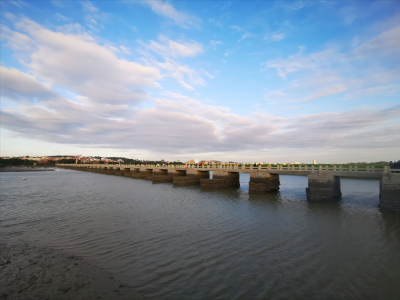
Luoyang Bridge, also called "Wan'an Bridge". When the Luoyang Bridge was not yet built, there was an original ancient ferry —— Wan'an Ferry, hence the name. Luoyang Bridge is the earliest existing bridge bridge in China. It is known as "the first bridge in the sea" and is one of the "four famous Bridges" in ancient times.
 
During the Song Dynasty 1041-1048 AD. , Li Chong, a native of Quanzhou, began building pontoon Bridges on the Luoyang River, but they were often washed away by wind and waves. In 1053 AD, CAI Xiang, the governor of Quanzhou, presided over the Luoyang Bridge construction project, which was completed in 1059 AD. The project lasted for six years, and finally built the big stone bridge across the river and the sea. The bridge is 834 meters long and 7 meters wide. The bridge body is "northeast-southwest", with 45 stone piers, the left and right wings of the deck to the column. On both sides, there are 500 stone carvings and 28 stone lions, dotted with 7 pavilions and 9 towers. The warrior statues are divided at both ends, and 700 pine trees are planted on the north and south sides of the bridge.
 
Luoyang Bridge has made many great achievements in ancient bridge construction technology, among which the most important has three kinds, namely "raft building foundation" method, "oyster planting base" method and "floating suspension bridge" method.
 
building structure
The end of the Luoyang piers is in the shape of a boat, and there are railings on both sides with stone carvings to protect pedestrians. Stone towers are built on both sides of the bridge to keep the wind down. Outside the fence beside the bridge. Still in the form of stone pagoda, the relief of the Buddha, patterns are clearly visible. Stone pavilions are built on the bridge for passers-by to rest. The bridge body and its ancillary buildings, there are many artistic stone towers, beautiful in shape: stone lions with heads held tall and straight, and ball lions with stone balls. The pavilion in the center of the bridge is engraved with the stone carvings of all dynasties.
 
technological problem
Luoyang Bridge is located at the confluence of the river and the sea in Fujian Province, where the river tide is surging and the waves fight. It was under this difficult conditions that Chinese bridge engineers a thousand years ago pioneered a new bridge foundation ── "raft foundation" which was not known until modern times. The so-called "raft foundation" is to throw a large number of stones along the midline of the bridge, forming a low stone embankment at the bottom of the river, and then build piers on the embankment. The piers of Luoyang Bridge are interlaced with long stones, with points at both ends, to divide the water potential and reduce the impact of the waves on the piers. In order to consolidate the cornerstone, the ancient Chinese working people also pioneered the "oyster solid foundation planting method", that is, breeding oysters on the cornerstone to make it bond into a solid mainstay, which is a precedent for the application of biology in bridge engineering in the world. It can still be seen from the piers filled with the marks of white oyster houses.
 
Value significance
The Luoyang Bridge has opened up a new era for the bridge technology. When the Luoyang Bridge was built, the bridge across the sea, not even in the whole of the Middle Ages (from the late 5th century to the middle of the 15th century AD). Today, the oldest stone bridge across the river in Europe is the Vizio Bridge, also known as the old Bridge, Italy. It was built in 1345 AD, 286 years after the Luoyang Bridge.
 
South shaolin Temple
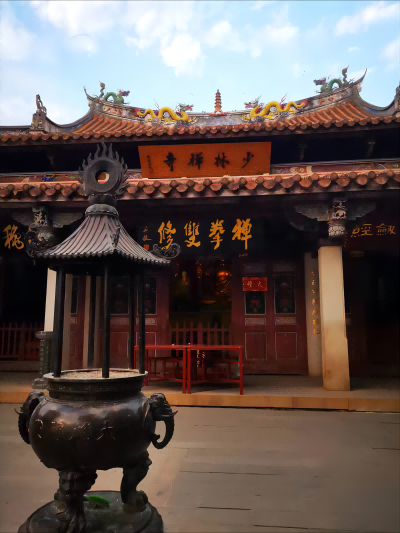
Quanzhou East Enguo Temple, commonly known as the South Shaolin Temple, relative to the Shaolin Temple in Henan Province, northern of China. Legend has it that it was the birthplace of southern Chinese martial arts. South Shaolin is located at the eastern foot of Qingyuan Mountain in Quanzhou. Legend has it that it was built by one of the thirteen monks of saving Emperor Li Shiming in the Tang Dynasty. Historically,  Quanzhou South Shaolin Temple was a huge building complex, with a total of thirteen buildings, east to the foot of the Dongyue Mountain, east to the East Gate moat, south to the East Lake, north to the Islamic cemetery. The existing East Shaolin Temple is only a small part of the Shaolin Temple in Quanzhou.
 
East Zhenguo Zen Temple, built in the Tang Dynasty 874-879 AD,  prosperous in the Song Dynasty, after several rise and downs in history. But south Shaolin martial arts also along broadcasted over sea, and its boxing schools were far broadcasted worldwide. During the Ming and Qing dynasties, Quanzhou port declined. Southern Shaolin martial arts also spread overseas with the Quanzhou immigrants, flourishing, extensive influence. Quanzhou is the birthplace of South Shaolin martial arts. It has a long history of martial arts activities, and the martial arts culture represented by South Shaolin Wushu is an important part of Quanzhou's cultural accumulation.
 
The north and south Shaolin belong to the same origin, and its spiritual outlook is basically similar. North and south Shaolin Temple have experienced disaster, but they possess same Shaolin spirit passed down by the Shaolin disciples.

More Attractions

  • Wuyi Mountian
    Wuyi Mountian
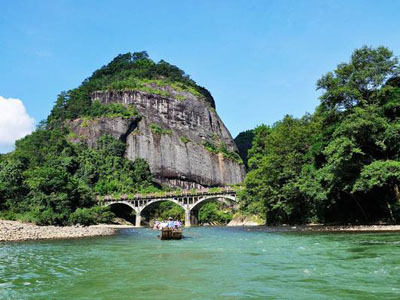
    Wuyi Mountain area is often called the number one scenic wonder in Southeast China. An anci......
  • Gulangyu Island
    Gulangyu Island
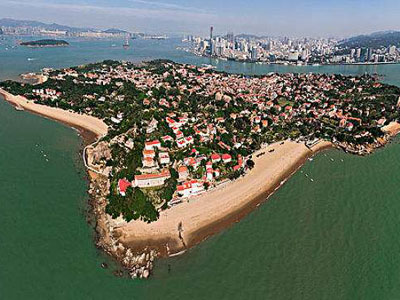
    The island, which is just under two kilometers square, is a five-minute ferry ride from Xia......
  • Yongding Tulou in Fujian
    Yongding Tulou in Fujian
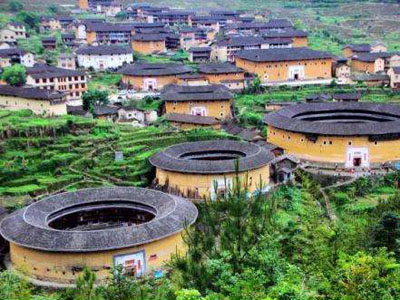
    Tulous structure, decoration and building technologies are rarely seen worldwide. Tulou, or......

Recommended Tours

Mt. Wudangshan Off-beaten Track Tour in Hubei

It is overland tour to Mt. Wudangshan in Hubei province from Xian. Hubei province is located in mid China connecting many provinces in China by convenient transportation of railway, cruise, and flights......

1 Day Chengdu Harmoney Tours of Mt Qingchengshan and Dujiangyan Dam

One day classic tours of Chengdu to Mt. Qingchengshan and Dujiangyan Dam will show tourist the profound of ancient Chinese wisdom and culture in harmony relation with the world. ......

1 Day Chengdu Giant Panda and Leshan Buddha Day Trip

The most classic one day Chengdu tours will bring tourist to Chengdu Giant panda garden and Leshan giant buddha with private travel guide and car in Chengdu, extremely convenient and easy!......

1 Day Best Chengdu Tours of Sanxingdui and Giant Panda Garden

One days best Chengdu tours bring tourist to Sanxingdui museum and giant panda garden with private guide and car, making your tour in Chengdu easy. ......

1 Day Chengdu Panda Volunteer Tour in Dujiangyan/Wolong/Bifengxia

This panda volunteer work provide tourist with one days unique experience of Panda volunteer project works and bring them an intimate touch with Giant pandas, also the best way to learn deep about pand......

2 Days Mt. Emeishan and Leshan Bullet Train Adventure

It is tour from the only one operator in Chengdu tours market offering Emeishan and Leshan tours by bullet train. Our highlights including Leshan Giant Buddha and Mt Emeishan. ......

Popular China Packages
  • Top 10 China Tours
  • Yangtze Cruise Tours
  • China Short Trips
  • Tibet Tours
  • Sichuan Tours
  • Yunnan Tour
  • Guilin Tour
  • Xiamen Tours
Adventure Tours
  • Overland Off-road Tours
  • Culture & Folklore Tours
  • Wildlife Exploration Tours
  • Trekking & Hiking Tours
  • Eco-Tour
  • M.I.C.E. & Event
  • School and Education Tours
  • Honeymoon Tour
China Travel Guide
  • Travel to China
  • China Visa and Permit
  • China Attractions
  • Chinese culture
  • China Nature Reserves
  • City Guide
  • China Maps
  • China Travel News
  • FAQS
Follow Us
Keep me updated
  • Stay up-to-date with the latest news direct to your inbox.

Address: 35th, Yangguang Business Center, Jinjiang District, Chengdu, Zip610065, China
About us | Contact us | Teams and Condition | Customer Center | Site Map
TEL: 028-86270775 E-mail: info@chinaexploration.com
Working hours:9:00AM-6:00PM(GMT+8)),Copyright(2003-2025) 蜀ICP05000963号 China Exploration Tour

  • Email: info@chinaexploration.com
  • Telephone: 86-28-86270775