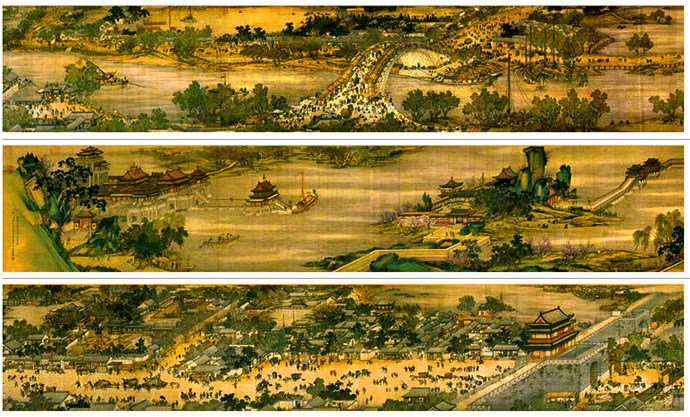
Along the River During the Qingming Festival (Qingming Shanghe Tu) is one of the most celebrated masterpieces in the history of Chinese painting. The original work is generally attributed to Zhang Zeduan (1085–1145), a painter of the Northern Song Dynasty. The panoramic handscroll depicts the bustling daily life of people in Bianjing, the capital of the Northern Song Dynasty and present-day Kaifeng.
Rather than focusing on the ceremonial aspects of the Qingming Festival, such as tomb sweeping and ancestral worship, the painting captures the lively atmosphere of the festival and the everyday activities of people from different walks of life. It portrays a remarkable range of social and economic activities, from rural life and farming to commerce and entertainment in the city. The scroll also provides valuable details of period clothing, architecture, transportation, bridges, boats, shops, and street life, making it an important visual record of Song Dynasty society.
The painting is renowned not only for its historical value but also for its extraordinary artistic precision. The carefully rendered buildings, boats, bridges, streets, and landscapes demonstrate the artist's remarkable ability to depict a complex urban environment. Because of its fame and cultural significance, it is sometimes described as the "Mona Lisa of China."
The original scroll has had a fascinating history. Like many famous works of art, it changed hands among various collectors before eventually returning to public ownership. It was once part of the former imperial collection, and Emperor Puyi took it with him when he left the Forbidden City for Manchukuo. After the end of World War II, the painting was recovered and eventually returned to China. It is now preserved at the Palace Museum in Beijing.
The fame of the original inspired numerous artists in later dynasties to create their own versions. Around 20 to 30 known variations were produced during the Ming and Qing dynasties, and examples can be found in museums and private collections around the world. While these versions generally follow the composition of Zhang Zeduan's original, their details, artistic styles, and historical settings often differ considerably.
The Northern Song original in Beijing and a famous Qing Dynasty version in the National Palace Museum in Taipei are regarded as national treasures. Because of their fragility and exceptional value, they are displayed only on special occasions and for limited periods. When the original is exhibited in Beijing, it can attract enormous crowds, with visitors sometimes waiting several hours for a chance to see this extraordinary masterpiece.