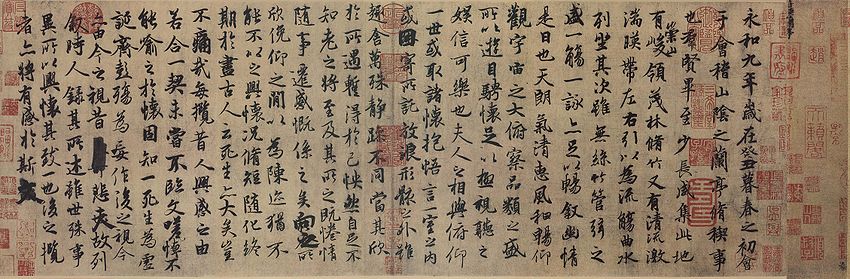
The Orchid Pavilion Preface (Lantingji Xu, or Lanting Xu) is widely regarded as the most famous work of Chinese calligraphy by Wang Xizhi (303–361), one of the greatest calligraphers in Chinese history. Written in 353 during the Eastern Jin Dynasty, it is composed in a semi-cursive style and has been copied and studied by calligraphers for centuries.
The work describes a gathering of 42 scholars, including the prominent figures Xie An and Sun Chuo, at the Orchid Pavilion near present-day Shaoxing in Zhejiang Province. The gathering took place during the Spring Purification Festival, when the participants enjoyed wine, composed poetry, and appreciated the beauty of the surrounding landscape.
According to the account, the scholars took part in a drinking game known as liushang qushui. Wine cups were floated along a winding stream, and whenever a cup stopped near one of the participants, that person had to drink the wine and compose a poem. By the end of the gathering, 26 participants had produced 37 poems. Wang Xizhi then wrote a preface to commemorate the occasion.
The preface contains 324 Chinese characters arranged in 28 lines. The character zhi (之) appears 20 times, yet Wang Xizhi wrote each occurrence in a different form. This demonstrates his extraordinary mastery of calligraphic variation. The text is also celebrated as a masterpiece of classical Chinese literature, with a natural rhythm and elegant prose. Its spontaneous revisions reveal that it was written as an improvisation rather than as a carefully prepared final draft.
The original manuscript has not survived, but its history has become part of Chinese cultural legend. Emperor Taizong of the Tang Dynasty was an ardent admirer of Wang Xizhi's calligraphy and became determined to obtain the original Orchid Pavilion Preface. According to tradition, the manuscript had been secretly passed down through the Wang family for generations. Eventually, it came into the possession of the monk Zhiyong, a descendant of Wang Xizhi who died without an heir. Zhiyong entrusted it to his disciple, the monk Biancai.
Emperor Taizong sent emissaries three times to ask Biancai for the manuscript, but Biancai insisted that it had been lost. The emperor then dispatched the official Xiao Yi, who disguised himself as a traveling scholar and gradually gained Biancai's trust. Eventually, Xiao Yi persuaded him to bring out the treasured manuscript. He then revealed his identity and took the work back to the imperial court.
Emperor Taizong was delighted to obtain the masterpiece. He ordered it to be carefully copied and engraved on stone so that its calligraphic beauty could be preserved and transmitted to later generations. According to legend, he was so attached to the original that it was eventually buried with him in his tomb after his death.
The dramatic story of Emperor Taizong's acquisition of the Orchid Pavilion Preface has inspired numerous legends, plays, novels, and works of art. Although the original manuscript is believed to have been lost, numerous tracing copies, reproductions, and stone inscriptions have survived, allowing generations of calligraphers to study and appreciate Wang Xizhi's unparalleled artistry.