




search for a Trip
Introduction of Xi’an
Xi’an, known as Chang’an in ancient times, is one of the most important historical cities in China and a world-renowned center of ancient civilization. Along with Athens in Greece, Rome in Italy, and Istanbul in Turkey, Chang’an is widely recognized as one of the great capitals of ancient civilization.
With a history spanning more than 3,000 years, Xi’an served as the capital of 11 Chinese dynasties, including the powerful Han and Tang dynasties. For over 1,100 years, it was the political, economic, and cultural heart of China, where numerous emperors ruled and where Chinese civilization reached remarkable heights.
Xi’an was also the eastern starting point of the ancient Silk Road. In 139 BC, the Han Dynasty diplomat Zhang Qian began his historic journey westward from Chang’an, opening routes that connected China with Central Asia, the Middle East, and Europe. Over time, Chang’an developed into a vibrant international metropolis where different cultures, religions, and ideas from East and West came together.
The prosperity of ancient Chang’an left behind an extraordinary collection of historical treasures. Today, Xi’an is home to world-famous attractions such as the Qin Dynasty Terracotta Army, ancient city walls, imperial tombs, Buddhist temples, and historic monasteries. These cultural landmarks provide visitors with a unique opportunity to explore the depth and richness of Chinese history.
Beyond its imperial heritage, the Xi’an region also preserves evidence of early Chinese civilization. Archaeological discoveries around the city reveal settlements and cultural sites dating back approximately 6,000 years, offering valuable insights into the origins and development of Chinese society.
Today, Xi’an is a must-visit destination in China, combining ancient history, Silk Road heritage, traditional culture, and modern city life. As the gateway to northwest China, Xi’an continues to welcome travelers from around the world who wish to experience the roots of Chinese civilization.
Main attractions in Xi’an
The terracotta warrior
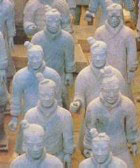
Emperor Qin was the first king of whole China. The Terra-cotta Museum is not only a treasure house where the tourists can learn history, culture and human civilization, but also a main scenic spot of Xi’an city. It can receive about 1.5 million tourists annually. Approximately 40 million visitors from home and abroad have visited the Museum within the last 20 years. Today "the eighth Wonder of the world" has almost become synonym of the Terra-cotta Warriors and Horses In 1987, the Emperor Qin’s Mausoleum was put on the list of the UNESCO as a world-class cultural heritage site. Now the Museum is well-known widely as a huge modern on-site museum and it is going to be one of the best in the world.
Big Wild Goose Pagoda
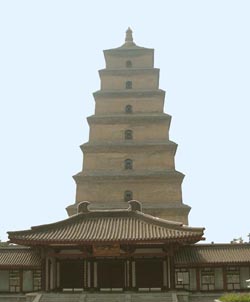
 Situated inside Ci’an(Thanks-giving)Temple, four kilometers south of Xi’an City, is one of the famous Buddhist pagodas in China. Sponsored by Tang Emperor Gaozong, the temple was first built in652 during the Tang dynasty as a symbol of thanksgiving to his mother for her kindness who had suffered an early death. Xuan Zang ,a famous Tang monk, made a proposal to the court for a pagoda, named the Big Wild Goose Pagoda was first erected in the past centuries. Legend related that one day a group of big wild geese flew over, suddenly one of them dropped from the sky and died on the ground. Monks were at a loss and did not know what to do They said that the dead wild goose was a Buddha. They buried the goose and a pagoda was erected, hence the name, the Big Wild Goose Pagoda.
The City Wall of the Ming Dynasty
The City Walls were built in the period 1374 to 1378.They were placed on the Foundation of the wall around the Tang Dynasty. Since the location of Xi’an gives it strategic military importance, the Walls are very tall and were fortified. Much of the magnificent 600-odd-year-old wall is still standing and it is one of the best examples in China of an outstanding traditional city defense system and urban design.
Shaanxi History Museum
Shaanxi History Museum, which located in the northwest of the Dayan Pagoda of ancient city Xi’an, is the first huge state museum with modern facilities in China, and given the reputation of "bright pearl of ancient city, treasure house of China." As the imperial capital since ancient times, more than 13 feudal dynasties built their capitals there in history including Zhou, Qin, Han, Tang. The province is rich in cultural relics. With the completion of Shaanxi History Museum, it collected over 370,000 precious relics which were unearthed in Shaanxi Province, large quantities, full categories, high grade. The bronze wares, pottery figures, and mural paintings in Tang tombs and so on, are all wonderful artistic treasures.
The Xi’an Forest of Calligraphy Museum
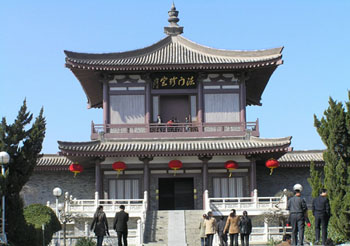 Establish in 1900 during the Northern Song Dynasty, the Calligraphy Forest in Xi’an is known world wide for a fine collection of more than 1000 inscribed stone monuments engraved during the period from the Han to the Qing dynasties for more than 2000 years.
The Calligraphy Forest in Xi’an is not only a treasure house of Chinese ancient Calligraphy, but also a rich collection of China’s historical documents and records and stone carving patterns. These steles record a part of the great achievements of the Chinese culture and a testimony to the cultural exchanges between China and other parts of the world.
Mount Huashan
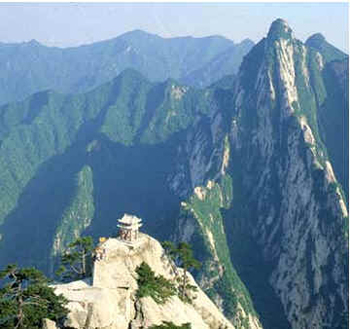 Mount Huashan is located in the eastern part of Shanxi Province belonging to the eastern section of Mount Qinling. Seen from a distance, it looks like a flower, hence the name Mount Hua. Its peak is Mount Taihua, known in the ancient times as the Western Mountain in Shanxi Province at an elevation of 2160 meters.
Famen Temple
For religious believers, the Famen Temple,110 kilometers west of Xi’an, is a sacred site. Built in the Eastern Han Dynasty, the temple is famous for housing the Buddhist relics of Sakyamuni, founder of Buddhism. Xi’an witnessed its golden age in development in the Tang Dynasty, when it was the largest city in the Orient and the staring point of the Silk Road,Connecting Asia with Europe.
Huaqing Hot Spring
Huaqing Hot spring is situated about 25 kilometers away in the northeast of Xi’an. It used to be a former winter resort for emperors. Its natural beauty and many historical episodes connected with this spot are the attractions. The place did not gain national fame until747, when Emperor Xuan Zong of the Tang Dynasty extended the palaces and built Huaqing Hot Pool, Using water from the natural hot spring, hence the name Huaqing Hot spring.
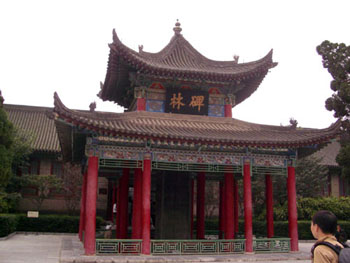
The Great Mosque
During the prosperous Tang Dynasty large number of Moslems traveled the world-famous Silk Road to Chang’an bringing Islam to China. With the support of the Tang emperor Xuanzong, they established the Great Mosque in 742.It is a well-preserved example of cultural merging, having been renovated several times and preserved by the Chinese Government. The Mosque exhibits the signification of overseas architecure. From the carving and furniture inside to the eaved pagoda for the minaret, Chinese influence is apparent.
Climate in Xi'an
The hottest and most unpleasant month is June, with an average temperature of 26 degrees C. The summers here can also be very dry so make sure you have plenty of drinking water with you when you go sightseeing!! The average temperature for the year is 13 degrees C.
| Month |
Jan |
Feb |
Mar |
Apr |
May |
Jun |
Jul |
Aug |
Sep |
Oct |
Nov |
Dec |
|
Temperature (Celsius) |
-3.1 |
-2.3 |
5.5 |
10.1 |
15.8 |
19.0 |
34.8 |
33.4 |
25.4 |
18.4 |
14.1 |
8.7 |
China Attractions Guide
- Anhui Attractions
- Beijing Attractions
- Chongqing Attractions
- Fujian Attractions
- Gansu Attractions
- Guangdong Attractions
- Guangxi Attractions
- Guizhou Attractions
- Hainan Attractions
- Henan Attractions
- Hongkong Attractions
- Hubei Attractions
- Hunan Attractions
- Heilongjiang Attractions
- Inner Mongolia Attractions
- Jiangsu Attractions
- Jilin Attractions
- Jiangxi Attractions
- Liaoning Attractions
- Manchuria Attractions

