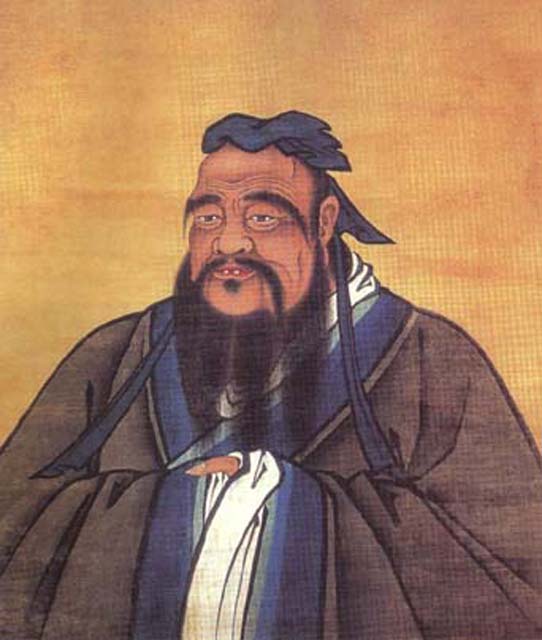
The myth of origins told by proponents of Confucianism (and by plenty of modern historians) begins with Confucius, whose Chinese name was Kong Qiu and who lived from 551 to 479 B.C.E. Judging from the little direct evidence that still survives, however, it appears that Kong Qiu did not view himself as the founder of a school of thought, much less as the originator of anything.
What does emerge from the earliest layers of the written record is that Kong Qiu sought a revival of the ideas and institutions of a past golden age. Employed in a minor government position as a specialist in the governmental and family rituals of his native state, Kong Qiu hoped to disseminate knowledge of the rites and inspire their universal performance. That kind of broad-scale transformation could take place, he thought, only with the active encouragement of responsible rulers.
The ideal ruler, as exemplified by the legendary sage-kings Yao
and Shun or the adviser to the Zhou rulers, the Duke of Zhou, exercises ethical suasion, the ability to influence others by the power of his moral example. To the virtues of the ruler correspond values that each individual is supposed to cultivate: benevolence toward others, a general sense of doing what is right, loyalty and diligence in serving one's superiors. Universal moral ideals are necessary but not sufficient conditions for the restoration of civilization.
Society also needs what Kong Qiu calls li , roughly translated as "ritual." Although people are supposed to develop propriety or the ability to act appropriately in any given social situation (another sense of the same word, li), still the specific rituals people are supposed to perform (also li) vary considerably, depending on age, social status, gender, and context.
In family ritual, for instance, rites of mourning depend on one's kinship relation to the deceased. In international affairs, degrees of pomp, as measured by ornateness of dress and opulence of gifts, depend on the rank of the foreign emissary. Offerings to the gods are also highly regulated: the sacrifices of each social class are restricted to specific classes of deities, and a clear hierarchy prevails.
The few explicit statements attributed to Kong Qiu about the problem of history or tradition all portray him as one who "transmits but does not create." Such a claim can, of course, serve the ends of innovation or revolution. But in this case it is clear that Kong Qiu transmitted not only specific rituals and values but also a hierarchical social structure and the weight of the past.
The portrayal of Kong Qiu as original and the coalescence of a self- conscious identity among people tracing their heritage back to him took place long after his death. Two important scholar-teachers, both of whom aspired to serve as close advisers to a ruler whom they could convince to institute a Confucian style of government, were Meng Ke (or Mengzi, ca. 371-289 B.C.E.) and Xun Qing (or Xunzi, d. 215 B.C.E.).
Mengzi viewed himself as a follower of Kong Qiu's example. His doctrines offered a program for perfecting the individual. Sageliness could be achieved through a gentle process of cultivating the innate tendencies toward the good. Xunzi professed the same goal but argued that the means to achieve it required stronger measures. To be civilized, according to Xunzi, people need to restrain their base instincts and have their behavior modified by a system of ritual built into social institutions.
It was only with the founding of the Han dynasty (202 B.C.E.-220 C.E.), however, that Confucianism became Confucianism, that the ideas associated with Kong Qiu's name received state support and were disseminated generally throughout upper-class society. The creation of Confucianism was neither simple nor sudden, as three examples will make clear.
In the year 136 B.C.E. the classical writings touted by Confucian scholars were made the foundation of the official system of education and scholarship, to the exclusion of titles supported by other philosophers. The five classics (or five scriptures, wujing) were the Classic of Poetry (Shijing), Classic of History (Shujing), Classic of Changes (Yijing), Record of Rites (Liji), and Chronicles of the Spring and Autumn Period (Chunqiu)
What in all of this, we need to ask, was Confucian? Or, more precisely, what kind of thing is the "Confucianism" in each of these examples? In the first, that of the five classics, "Confucianism" amounts to a set of books that were mostly written before Kong Qiu lived but that later tradition associates with his name.
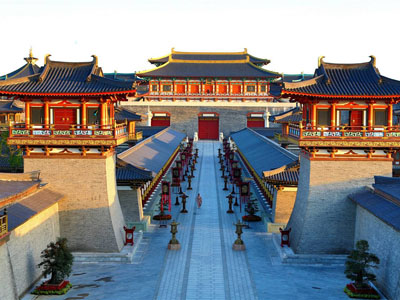
It is a curriculum instituted by the emperor for use in the most prestigious institutions of learning. In the second example, "Confucianism" is a complex ritual apparatus, an empire-wide network of shrines patronized by government authorities. It depends upon the ability of the government to maintain religious institutions throughout the empire and upon the willingness of state officials to engage regularly in worship.
In the third example, the work of Dong Zhongshu, "Confucianism" is a conceptual scheme, a fluid synthesis of some of Kong Qiu's ideals and the various cosmologies popular well after Kong Qiu lived. Rather than being an updating of something universally acknowledged as Kong Qiu's philosophy, it is a conscious systematizing, under the symbol of Kong Qiu, of ideas current in the Han dynasty.
Related Tours