



China Exploration - China Adventure Tours and Travel Service
  • China Exploration - China Adventure Tours and Travel Service
  • 86-28-86270775
  • info@chinaexploration.com
  • Tour Code Search
  • HOME
  • China Tours
    • Top 10 China Tours
    • Classic China Tours
    • Yangtze Cruise Tour

        Yangtze Cruise Routes

        Yangtze Cruise Calendar

    • Join-in Group Tours
    • Short Stay Tours

        144 hours VISA free tours

        Less than 7 days tours

    • Family Tours
  • Adventure Tours
    • Overland Off-road Tours
    • Culture & Folklore Tours
    • Wildlife Exploration Tours
    • Trekking & Hiking Tours
    • Eco-Tour
    • M.I.C.E. & Event
    • School and Education Tours
  • DESTINATIONS
      BeijingChengduChongqingDaliDatongGuilinGuiyangHangzhouHongkongHuangshanKunmingLanzhouLhasaLijiangLuoyangPingyaoSanyaShanghaiShangrilaHohhotUrumqiWuhanXiamenXi’anXiningYinchuanZhangjiajie Explore All Destinations>>
  • Customized your trip
  • TRAVEL GUIDE
    • Travel to China
    • China Visa and Permit
    • Chinese Attractions
    • Chinese Culture
    • China Nature Reserve
    • China City Guide
    • China Maps
    • China Travel News
    • Hotel Booking
    • FAQS
  • About Us
    • Contact Us
    • Our Team
    • Our Glory
    • Olympic Torch Bearer
    • Feedback
    • Photo Album
    • Travel Story
    • Travel Video
    • Teams and Condition
    • Insurance Policy
    • Site Map
  • China Tours
  • Top 10 China Tours
  • Classic China Tours
  • Join-in Group Tours
  • Short Stay Tours
  • Family Tours
  • Adventure Tours
  • Overland Off-road Tours
  • Culture & Folklore Tours
  • Wildlife Exploration Tours
  • Trekking & Hiking Tours
  • Eco-Tour
  • M.I.C.E. & Event
  • School and Education Tours
  • Honeymoon Tour
  • DESTINATIONS
  • Beijing Tours
  • Chengdu Tours
  • Chongqing Tours
  • Dali Tours
  • Dalian Tours
  • Datong Tours
  • Guilin Tours
  • Guiyang Tours
  • Guangzhou Tours
  • Haerbin Tours
  • Hangzhou Tours
  • Hohhot Tours
  • HongKong Tours
  • Huangshan Tours
  • Kashgar Tours
  • Kunming Tours
  • Lanzhou Tours
  • Tibet Tours
  • Lijiang Tours
  • Luoyang Tours
  • TRAVEL GUIDE
  • Travel to China
  • China Visa and Permit
  • Chinese Attractions
  • Chinese Culture
  • China Nature Reserve
  • China City Guide
  • China Maps
  • China Travel News
  • Hotel Booking
  • FAQS
  • About Us
  • Contact Us
  • Our Team
  • Our Glory
  • Olympic Torch Bearer
  • Feedback
  • Photo Album
  • Travel Story
  • Terms And Condition
  • Insurance Policy
  • sitemap
Home > TRAVEL GUIDE > Chinese culture > Silk Road
Mogao Grottoes and Dunhuang Culture Studies
The Mogao Grottoes, located at the western end of the Hexi Corridor in Dunhuang City. Its excavation, from the Sixteen Kingdoms period to the Yuan Dynasty, lasted for about 1,000 years, which is the only one among the Chinese grottoes. The Mogao Grottoes are not only a splendid artistic treasure house of ancient Chinese civilization, but also an important witness of the dialogue and exchanges between different civilizations that took place on the ancient Silk Road. There are 735 caves in the Mogao Grottoes, with more than 45,000 square meters of preserved murals, more than 2,400 colored sculptures, and 5 eaves of wooden structure grottoes in the Tang and Song dynasties. Mogao Grottoes is an epitome of the development and evolution of Chinese grotto art, and enjoys a lofty historical position in the grotto art. The main paintings and sculptures of Buddha statues and Buddhist scriptures in the cave, which are the places of Buddhist practice, viewing and worship. Dunhuang Grottoes are a three-dimensional art combining architecture, sculpture and murals. The caves are divided into two districts: the 492 caves in the southern district are the places for Buddha worship in the Mogao Grottoes, while the 243 caves in the northern district are mainly the residences of monks and craftsmen, with cultivation and living facilities, such as kang pits, tunnels, niches and lamp platforms, but most of them do not have colored sculptures and murals.
 
The Dunhuang Grottoes is usually used to refer to the Mogao Grottoes, which is the general name of the Mogao Grottoes and the West Thousand Buddha Cave, sometimes including the Yulin Grottoes in Anxi. Dunhuang Grottoes, along with Yungang Grottoes in Datong, Shanxi and Longmen Grottoes in Luoyang, Henan, are the three major grottoes in China. In 1961, The State Council announced the Mogao Grottoes and Yulin Grottoes as the national key cultural relics protection units. In 1987, the Mogao Grottoes were listed in the World Heritage List as a cultural heritage.
 
Dunhuang is located in the western part of Gansu Province, located at the western end of the Hexi Corridor. It is connected to Qinghai to the south and Xinjiang to the west. It has been the hub of transportation between China and the West since the Han Dynasty. In 111 BC, Emperor Wudi of the Han Dynasty set up Dunhuang County as a border post to resist the Xiongnu. Since the opening of the Silk Road by Emperor Wudi of the Han Dynasty, Dunhuang, as an important town in the western region, has become a transportation hub connecting the Central Plains and the Western Regions, a commercial center along the Silk Road, and a field for the intersection of various nationalities and cultures. Among them, Chinese and Western civilizations, including Buddhist culture and art, meet and collide here, which is the historical root of dunhuang grotto art.
 
The History of Mogao Grottoes
The time of building Mogao Grottoes are slightly different in different documents. At present, most scholars agree with the view that it was started from the second year of the former Qin Jianyuan (366 AD) when Monk Le Zhun dug caves in the Mogao Grottoes, and then Zen Master Faliang continued to build them. By the Beiliang period, a small community of monks had been formed here. These caves began served as meditation places for hermit monks, but later developed to serve the rise of the nearby monasteries. Since then, under the influence of Buddha worship statues, the Mogao Grottoes began to develop rapidly. In the early Sui and Tang dynasties, Dunhuang became the main commercial hub and an important religious center of the Silk Road. Meanwhile, the Mogao Grottoes also entered its heyday and became a place of pilgrimage for all parties. During this period, numerous caves were built in the Mogao Grottoes, including two large image niches. As an aid to meditation, as a teaching tool to promote Buddhist beliefs and stories to the illiterate, the caves and interior murals and statues are carefully built. The main caves are usually sponsored by Buddhist monks, local ruling elites, and emperors of the Central Plains, while others are funded by business travelers, military officers, and local people (such as women's groups).
In the 914 AD, the Cao Yijin family ruled Guazhou (Anxi) and Shazhou (Dunhuang) for more than 120 years. They built a large number of caves in Dunhuang, repainted and rebuilt the caves and eaves of the previous generation, and painted large areas of open-air murals on the cliff surface, making the appearance of Mogao Grottoes magnificent.
 
During the scenic period of the Northern Song Dynasty, Dunhuang was successively ruled by the Xixia and the Mongolian regime. Although there were still some things restored and repaired, the Mogao Grottoes declined with the loss of the important role of the Silk Road and the economic depression of Dunhuang. After the yuan yuan, stop opening the caves.
 
The discovery of the Mogao Grottoes
The Mogao Grottoes were once abandoned in the Ming Dynasty and were little-known. It was not until the 20th century that Dunhuang attracted the attention of the world again, which was closely related to the discovery of the Sutra cave by Wang Yuanlu (1849-1931). Wang Yuanlu was a Taoist priest who came to the Mogao Grottoes in Dunhuang around 1890 AD and settled there. He described himself as the folk guardian of the grottoes and went to raise money to repair the temple. In the 1900, while cleaning the sand in Cave 16, one of his workers suddenly found a secret door with a small secret room, hidden full of volumes and paintings from the 4th to the 11th century. After the discovery of the cave, British M.A. Stein (Marc Aurel Stein, 1862-1943), French Bosch, Japanese Orange Ruichao and Jiro Yoshikawa successively took a large number of scriptures and other cultural relics in the cave. Russian S.F. Сергеи федорович Ольденбург (1863-1934) and American L. Warner also stole some murals in the Mogao Grottoes. These robberies and destruction caused great losses to Dunhuang cultural relics. At the same time, some of them began to number, map, photograph and write down the caves by archaeological methods, and published some photos and materials of the Dunhuang grottoes.
 
After more than 100 years, all the exposed and buried caves have been cleaned and excavated, archaeologists found that there are 248 caves in the area (including the numbered 461-465 caves), and basically clarified the structure, use, function and age of each (or group) caves. Among them, there are monk caves where monks lived, Zen caves for practice, grain caves for storage, and burial tombs, which have different forms and functions. Cleaning also unearthed many relics, coin of Persian silver coin, Kaiyuan tong bao, song dynasty copper iron coin, Xixia iron coin, wooden woodcarving terracotta figure, Huihe wooden movable type, clay sculpture tower, Buddha, shadow, copper cross, metal iron cutter and literature of Chinese, Xixia, Huihe, Tibetan, Mongolian, Sanskrit, eight thought, Syria and other kinds of ethnic literature and daily necessities, etc. Relics and relics show that the North District is an area where the monks move.
 
The modern research and protection of Dunhuang grottoes are also increasingly international and institutionalized. In 1983, the Dunhuang Turpan Society of China was established. In 1984, the expanded Dunhuang Institute of Cultural Relics was renamed the Dunhuang Academy. In 1987, the Dunhuang Mogao Grottoes were listed in the "World Cultural Heritage List" by UNESCO. In the same year, The Japanese Qingshan donated 8 pieces of Dunhuang cultural relics to the Dunhuang Academy, which was the first time that the lost overseas were returned to China.
 
The main attractions of the Mogao Grottoes
Nine Floors Tower
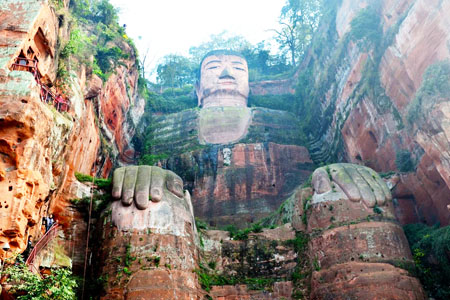
It is commonly known as the wooden building outside the cave 96. The Tang Dynasty was called the Great Northern Statue. Commonly known as the Giant Buddha Hall. Is one of the representative grottoes of the Mogao Grottoes. The first big grottoes in Dunhuang grottoes was built in the early Tang Dynasty. The cave to the top of the cliff, 40 meters high, nine layers of wooden buildings outside the cave, 45 meters high. There are no paintings on the walls of the cave, and the largest statue (33 meters high) in the Dunhuang grottoes is made like Maitreya Buddha. The height is second only to the Leshan Stone Buddha in Sichuan (71 meters) and the Stone Buddha in Rongxian, Sichuan (more than 36 meters). In the clay sculpture statue, its height is the crown of the whole country.
 
Three Floors
A cave built by a monk named Wu, the late Tang Dynasty called Wu monk cave. The Mogao Grottoes represent one of the grottoes. Built between the first five years to the eighth year of Xiantong (851-867). The master of the cave was Monk Wu, who was the master of Hexi in the late Tang Dynasty. Located in the ground floor of the north section of the southern district of the Mogao Grottoes. It is the 365 cave (seven Buddha hall), the top is the 366 cave, three caves in front of the three layers of wooden cave eaves, namely three floors.
 
Preserving Buddhist Sutra Cave
Cave 17 of the Mogao Grottoes, also known as the "Mingsha Stone Room" and "Dunhuang Stone Room", is located in the north wall of the tunnel of Cave 16. It was built between the fifth year of the Tang Dynasty to the third year of Xantong (851-862). It was originally the Buddhist cave of the late Tang Dynasty. After the death of Hong, his subordinate monk or Wu family changed the Zen Grottoes to the shadow Hall. The plane of the cave is nearly square, with a bucket top, the ground to the top of the cave is 3 meters high, the north wall of a rectangular Zen bed type low altar, sitting on the altar, a clay sitting statue of the monk Hong. North mural two bodhi tree, branches and leaves, to show that Hong sat under the bodhi tree. On the east side of the Bodhi tree, he holds a phoenix ball fan in both hands; on the west side, he draws a close woman with a towel in one hand and a staff in the other hand. The west wall embedded with a large five years hongbody monument. Tens of thousands of ancient Buddhist scriptures, social documents, silk paintings, embroidery, ritual ware and other cultural relics from the 4th century to the 11th century, which are commonly known as "Sutra cave".
 
The Mogao Grottoes Art Classification
 
Mural
Murals are one of the art contents of Dunhuang grottoes. Dunhuang Grottoes are a three-dimensional art combining architecture, sculpture and murals. Mural refer to the Buddha paintings painted on the corridors, four walls and the top of the grottoes. The cliff quality of Dunhuang grottoes belongs to the gravel rock layer of Jiuquan system, which is made of sand accumulation and pebble precipitation. Pebble is hard, stone is difficult to cut, loose sand layer, slightly touch that fall, not suitable for carving. Therefore, after the excavation, the ancients in the wall top and wall plaster with white powder, so that it is smooth and then painted on. Because the painting wall costs less labor than stone carving, it is easy to depict details. People with beans and an inch big horse can be carefully painted into the wall, so the content of the Buddhist scriptures and the social style of The Times are more extensive, rich and detailed than stone carving. This is the biggest characteristic and unique advantage of Dunhuang grottoes, which is different from other grottoes. In terms of quantity, the existing murals in Dunhuang grottoes are about 50,000 square meters, with the largest painting of more than 40 square meters. From the time point of view, from the late Beiliang of the Sixteen States to the Mongolian period, generations of phase, grottoes painting, for thousands of years.
 
In terms of the content, the murals can be divided into:
(1)The statue of the painting. Such as kyakyamuni Buddha, maitreya Buddha, amitabha Buddha, seven Buddha, three Buddha, etc. This kind of portraits are widely depicted in various caves of Dunhuang Grottoes.
(2) A biographical story painting of the Buddha. It depicts the biographical comics of Sakyamuni Buddha from birth, birth, growth, monk, penance, enlightenment, demons, Buddha and nirvana.
(3) Karma and story painting. Describe the deeds of Sakyamuni Buddha transforming all living beings. For example, "Sami keeps suicide fate", "Subtle Bichikkuni edge", "Sumoti female fate", "Five hundred robbers become Buddha fate", and various stories in "The Book of virtuous and foolish".
(4)Han nationality mythological theme pictures. For example, the prince of the East, the Queen mother of the West, Fuxi, Nuwa, Qinglong, white tiger, rosebird, Xuanwu, enlightened, fly lian, god of thunder, and so on. The above (2) to (4) theme murals are mostly painted in the early caves of Northern Liang, Northern Wei, Western Wei, Northern Zhou and Sui Dynasty.
(5) Buddhist historical trace paintings. It depicts the historical figures, events, Buddhist relics,  and pictures of various Swiss images of the spread of Buddhism. Such as "Zhang Qian visit western regions", "Buddha laundry pool", "Buddha sun stone", Buddha figure clear all kinds of god different story, and so on. According to statistics, there are as many as 67 kinds of such themes, from the early Tang dynasty to the Song dynasty and Yuan dynasties, with the most flourishing in the middle and late Tang dynasties and the Five Dynasties.
(6) Transformed painting. It is a picture of the Buddhist scriptures preached by the Shakya Buddha. This is the most important part of Dunhuang murals, the most paintings, and the string in various times. A total of more than 30 kinds, more than a thousand walls, especially from the Tang Dynasty to the five dynasties. Such as drop the demon change, nirvana by the change, Maitreya, the change, the prayer change, the rain by the change, the Buddha, abmen, view the Buddha, the change, China change, the change, the gold light, the change, the change, the day change, the change, the right to change, the change, the change, and the change, the change, the Tibetan Bodhisattva and ten king hall, etc.
(7) Paintings of sponsors. That is, the portraits and travel pictures of the owners of the grottoes and their families who made caves and painted Buddha. The status of the providers included monks, nuns, nobles, high officials, families, scholars, people, painters, craftsmen, servants and servants, people of all ethnic groups in northwest China, Kings, princes, businessmen from home and abroad, etc., with more than 5,000 people. For example, "The statue of the emperor", "the statue of Tibet", Zhang Haichao, Zhang Huaishen, Zhang Chengfeng, and Cao Yijin; Li Shengtian, the king of Yutian, Conglian, the prince of Yutian, the Princess of Yutian and the Uighur Princess of Ganzhou; the statue of Tubo, the nun, and the mother and daughter of "give up the good". The travel map is such as the travel map of Zhang Ytongjun, the travel map of the wife of Hanoi County of Song Dynasty, and the travel map of Cao Yijin, etc. In the early days, most of the followers were single, few servants, and the picture was small. After the Middle Tang Dynasty, the picture of the followers grew larger, except the caves, the children and grandchildren, servants, all the family members and the dead parents were included in the painting.
(8)Decorative pattern painting. The flat chess and the cajing painted on the top of the cave, the lintel, column and edge of the shrine and the head of the Buddha, the body, costumes, tables, carpets, murals and so on. The patterns have flowers and plants, lotus, branches and leaves, vines, fruit, flying, children, lion, flying horse, dragon, birds, hunting, flame, stars, clouds, grain, moment, beads, diamond and so on and their combination changes. Various decorative patterns and gorgeous colors. Modern architecture, printing and dyeing fabrics, decorations and other useful for reference.
 
As the Dunhuang frescoes continue to be painted for thousands of years, their art and content are of high value to the study of the history of Chinese painting and the ancient social history, especially in the history of northwest China.
 
Colour Scupture
One of the art contents of Dunhuang grottoes. Dunhuang Grottoes are a three-dimensional art combining architecture, sculpture and murals. Sculpture is the main body of the grottoes. Because the Dunhuang grottoes were dug into the conglomerate, except for the clay statues of 20 or 30 meters high, there are mostly wooden frame structures. The production process is: in the naturally grown branches similar to the posture of the Buddha, or artificial wooden frame with reed grass on the grass, grass outside the thick mud, then apply fine mud, press the statue shape, and then the white powder, and finally painting, hence the name color plastic.
 
Dunhuang colored sculptures lasted from the sixteen states, through the Northern Wei, Western Wei, Northern Zhou, Sui, Tang, Five Dynasties, Song, Uighur, Xixia, Yuan and Qing Dynasty, with more than 3,000 colored sculptures, including more than 2,000 round sculptures and more than 1,000 floating sculptures. More than 1,400 people, most of them have been painted or reshaped by posterity, and some have lost some or all of the original work. However, like the Mogao Grottoes, the preservation of ancient colored sculptures is rare in China and the world.
 
Building
The Regulation of the architectural form of Dunhuang Grottoes. The names of all kinds of grottoes of the Dunhuang grottoes are not recorded in written records, nor have they been circulated orally. The classification and naming, and after the shape of the rules, not the ancient appellation and model system, but according to its characteristics and named.
The forms of various grottoes in Dunhuang grottoes evolved according to the religious rituals of different periods, secular beliefs and national aesthetics, and combined with the development of local rocks according to the time and local conditions. With the passage of time, they were recognized and called by people.
 
The historical value of the Dunhuang Grottoes
The construction and historical process of Dunhuang grottoes, the long history of Dunhuang, the local influential families and family names, and the relationship between Dunhuang and the surrounding nationalities and the Western Regions were not or rarely recorded in history. But there are portraits of thousands of donors in the Dunhuang Grottoes, one thousand of which are preserved and nominated. Offering portraits and inscriptions, vivid, rich, and truly provide many historical conditions and historical clues. It makes us understand the history of Yin, Suo, Li, Zhai, Zhang, Cao and other big families, which are closely related to the history of Dunhuang and the construction of Dunhuang grottoes, and they created the historical facts of Dunhuang grottoes. They are all precious materials that study the history of Dunhuang during the reign of Zhang and Cao Gui. It also makes us understand the activities of Tuoba Xianbei, Tubo, Tuyuhun, Huihe, Dang and Mongolian minority regime in Dunhuang, the intricate relationship between the ethnic groups and their culture and art; It reflects the health system, the slave system, the Tubo official system and the rebel regime of the Tang Dynasty.
 
Ben, Buddha, Futian, Maitreya, Baoyu, Lenka, and the inscriptions of donors can help us understand the situation of ancient economic life. Such as agriculture and animal husbandry, there are farming, harvesting, fishing, pottery, livestock raising, hunting. Manor harvest map and temple harvest map, told us the news of the tang Dynasty manor and temple economy. In terms of handicrafts, there are forged iron, brewing, pottery making, spinning, weaving, brown, leather maker, shoe making, painting maker, painter, carpenter, plastic maker, paper maker, carpenter, stone maker, thugs, gold and silver smith, bowsmith, and stepping master. In business, there are butcher house, meat shop, wine restaurant, hotel, gold bank, wooden bank, bow line and so on. According to the literature records of the Sutra cave, there are more than 20 kinds of craftsmen. The combined study can reflect the appearance of handicraft industry and commerce in the ancient Dunhuang area. The French and nirvana economic changes provide the battle map of the ancient army training, war, expedition, attack and defense, as well as the valuable image data of weapons and equipment.
 
There are sports materials in Dunhuang murals, such as riding, shooting, target shooting, horse skill, horse jumping, sumo, wrestling, weight lifting (elephant lifting, bell lifting), playing chess, pot throwing, martial arts, swimming, polo, and Cuju, etc.
 
Dunhuang is the "throat" of the Silk Road. In the past of Hu merchants, it is also the place to engage in silk trade and transit. The murals depict the scene of merchants from the Central Plains and the Western Regions traveling eastward and westward along the Silk Road. For example, in the Cave 296 valley of the Northern Zhou Dynasty, on one side, hu merchants with high nose and deep eyes, holding camels carrying goods, and on the other side, Chinese merchants riding horses, driving donkeys loaded with goods, met on the bridge. At the same time, it also revealed the news of the difficulties and trade obstacles of the ancient Silk Road. For example, in the Fahua Sutra of Cave 420 of the Sui Dynasty, the caravan drove camels and donkeys loaded with silk, and met a large number of armed robbers, and the caravan was robbed; in the Guanyin Sutra of Cave 45 of the Tang Dynasty, a group of Hu merchants driving donkeys carrying silk met robbers in the valley.
 
The Silk Road is not only a road of trade, but also a road of diplomatic and cultural exchanges. Cave 323 of the Tang Dynasty, grottoes 98 and 454 of the Five Dynasties, grottoes 231,237,98,61,72 of the Middle Tang Dynasty, 5 Dynasties, and 29, and caves in the caves 323,9,108, and 454 of the Tang and Song Dynasties.
The folk customs scenes of food, clothing, shelter, transportation, birth, aging, illness and death, marriage and funerals are everywhere in the murals. The Maitreya Sutra from the heyday of the Tang Dynasty to the Xixia Dynasty generally described the marriage map, showing the Buddhist scriptures that Maitreya World Life was 84,000 years old, "a woman is 5000 years old, she can marry". The picture shows that two different marriage customs were widely popular in Dunhuang during the Tang and Song Dynasties. One is that under the influence of the traditional culture of the Han people, the men married the bride and got married. The wedding picture in the mural shows the setting of the wedding scene: set up tents in the courtyard, banquet for guests, surround the curtain of the newlyweds and the green cottage where the new couple live. Also showed the whole process of the wedding ceremony: the groom wedding, music and dance to add to the ceremony, the ceremony of Mo Yan, into the green cottage, held the bridal chamber with the prison ceremony. For example is the story from the Northern Zhou Dynasty to the Song Dynasty painting subtle bi, good prince into the sea, the Buddha, the nirvana meridian change, depicting the ancient funeral customs, depicting the coffin for the funeral, the funeral and funeral, the funeral process of the funeral of the earth, the tombs (built around the tomb wall), burial, the ground grave (heap mound) burial way.
 
Most of the colored sculptures and murals in Dunhuang grottoes are Buddhist contents: such as colored sculptures and statues of murals, Sakyamuni's life, karma, Buddhist story paintings, various Buddhist paintings, numerous Buddhist story paintings, mythical figure paintings, each of which has a large number of, rich and systematic materials. It also involves India, West Asia, Central Asia, Xinjiang and other regions. It can help us understand the ancient Buddhist thoughts, sects, beliefs and dissemination of ancient Dunhuang and the Hexi Corridor. The integration of Buddhism and traditional Chinese culture. The process of sinicization of Buddhism is extremely valuable data to the study of the history of Buddhism in Dunhuang area and the history of Chinese Buddhism.
 
Artistic value
Dunhuang grottoes built one thousand course, when two Han dynasty after long split, when the Chinese history after long split, to national integration, north and south unity, into the heyday of datang, and by the peak and declining important development period, during this period, it is Chinese art program, genre, category, the formation and development of theory, and introduction of buddhist art, establishment and development of Chinese Buddhism theory and Buddhism sect, buddhist art art become an important category of Chinese fine art, finally completed the period of Chinese. Dunhuang grottoes art, in one thousand, rich in content, huge, its art form inherited the local han jin art tradition, absorb the northern and southern dynasties and tang and song dynasty art genre style, and constantly accept, transformation, fusion outside India, central Asia, west Asia art style, shows a buddhist art history and the gradual course of Chinese. It is also a historical record of the exchanges and exchanges between Chinese art and the Western regions. It is of great significance to the study of Chinese art history and the world art history.
 
From the perspective of the categories of Chinese painting and art, the figure paintings, landscape paintings, animal paintings and decorative pattern paintings in Dunhuang grottoes murals have a history of one thousand years, their own characteristics, and can become an independent history of figure painting, landscape painting, animal painting and decorative pattern painting. In particular, it has preserved such rich examples of figure paintings, landscape paintings, animal paintings and decorative patterns before the 10th century, which are not seen in museums around the world. There are more than 200 groups of musical caves, painted with many bands, musicians and Musical Instruments. According to statistics, there are more than 500 groups of different types of bands, and more than 40 kinds of Musical Instruments, totaling more than 4,500 pieces. There are also music scores and other musical materials in the Dunhuang Sutra Cave literature. Rich music data and image data show the continuous development and change of Chinese music culture for nearly a thousand years. For the study of the history of Chinese music, the Chinese and Western music culture exchange provides precious materials.
 
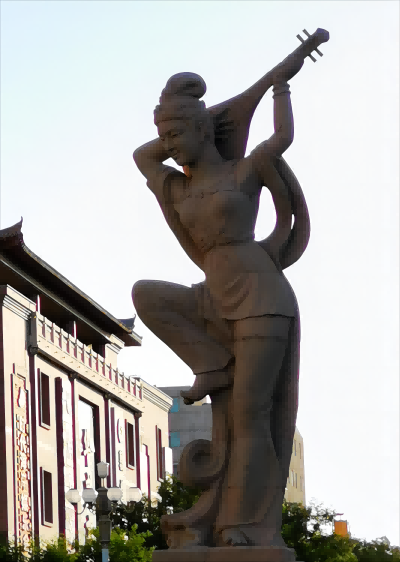
Most of the murals in the Dunhuang grottoes have dance images, including dance scenes and dance images reflecting the human social life and customs, such as western dances, folk banquet and wedding music; the court and noble swallow music scenes, the dance images of heaven and offering offerings. There are also the dance music and related materials preserved in the Sutra cave. Dance art is a space-time art that cannot be preserved. The ancient dance image is little known to modern people. In terms of the collection of dance images of Dunhuang grottoes, it can be called a museum of dance art, preserving countless superb dance skills and dance art images, representing the development appearance and development process of dance in various times.
 
Dunhuang grottoes art has a very rich architectural history data. From the 16 countries to the Xixia, Dunhuang murals depict thousands of architectural paintings involving different types, including Buddhist temples, city walls, palaces, que, grass nunnery, dome, tents, inns, hotels, slaughterhouses, beacon towers, Bridges, prisons, tombs and so on. These buildings have group buildings with courtyard layout, and single buildings. The murals also leave a wealth of architectural components and decorations, such as brackets, columns, Windows and doors, as well as architectural construction drawings. Thousands of architectural image information shows us a history of Chinese architecture. What is valuable is that the essence of Dunhuang architectural materials reflects the architectural appearance of the four hundred years from the Northern Dynasty to the Sui and Tang Dynasties, filling the gap of the lack of architectural materials from the Southern and Northern Dynasties to the prosperous Tang Dynasty. In addition, in different periods, more than 800 caves in different shapes, five wooden eaves in the Tang and Song Dynasties, and the relic towers of the cave temples are all valuable architectural material materials preserved in ancient times.
 
Science and technology value of Dunhuang
Life, Buddhist story painting, the change of Maitreya Sutra, the change of French Sutra, there are many ploughing pictures, showing a kind of seven harvest content. The picture shows the appearance of agricultural production in Dunhuang over the 600 years from the Northern Zhou Dynasty to the Western Xia Dynasty, Make us understand the whole process of agricultural production at that time: a farmer, Two cattle pull plow (two cattle lift bar) farmland, Women sow with baskets of seed seeds, Wearing a hat hat, The farmer, armed with a sickle, To harvest the ripe crops, The man swung the flail, With wooden branches and shovels, Women with dustpan, Yang basket Yang field, etc., The murals also vividly depicted various tools of agricultural production, In addition to the tools mentioned above, There are straight shaft plough, curved shaft plough, three feet columbine plough, iron share, rake, hoe, shovel, carrying pole, scale, dendrobium, bucket, rise, In particular, the image of the yuan, which can adjust the cultivation depth in cave 445 of the Tang Dynasty, It provided us with the only precious image data of the most advanced farming tools of the time.
 
As the hub of transportation between China and the West, Dunhuang not only leaves the activities of business travel, but also leaves the valuable image data of the means of transportation. They had cattle, horses, camels, mules, donkeys, like boats, carts, sedan chairs and chariots. Commonly used transportation vehicle types, cattle, "ox", "partial ox", convertible cattle, carriage has four, Locke, and camel, carriage, unicycle, especially save China for the world traffic unique contribution unicycle, horse set harness (chest belt harness and shoulder set harness), horse pedal, horseshoe palm and other precious image data. The 285 of five hundred blind thieves in the Western Wei Dynasty and the 296 cave in the Northern Zhou Dynasty shows the scene of the cavalry on a war horse fighting with the infantry (robbers) dressed in trousers. On the picture shows the horse armor, which is the protective equipment to protect the war horse, or armored. Cave 285 has a complete shape, from the "curtain" protecting the horse head to the "parasitic" protecting the tajiri. It reflects the existing equipment in the Han Dynasty, and has developed into a mature protection equipment in the Northern Dynasty. The emergence and development of Ma is China's unique contribution to the world military equipment.
 
Dunhuang retains the precious image data. From the Sui Dynasty to the Western Xia Dynasty, the Buddha, Bodhisattva, disciples in the hands and on the table, and glass dishes. They are transparent, light blue, light green, light brown, and the shape, color and decoration show the Western Sasanian style or Roman style. It shows that these glassware was imported from West Asia. The murals not only reflect the characteristics of the ancient glass technology, but also reflect the glass trade between China and the West. On June 22,1900 (May 26, the 26th year of Emperor Guangxu of the Qing Dynasty), Wang Yuanlu, a Taoist priest in the lower Mogao Temple in Dunhuang, accidentally discovered the Sutra cave (namely the cave 17). More than 50,000 pieces of Buddhist scriptures, social documents, embroidery, silk paintings and legal instruments were unearthed from the 4th to 11th centuries AD. This discovery, which shocked the world, provides a huge and rich precious materials for the study of ancient history, geography, religion, economy, politics, nation, nationality, language, literature, art, science and technology of China and Central Asia, and is known as "the encyclopedia of ancient times" and "the ocean of ancient scholarship". The rich connotation and precious value of Dunhuang grottoes and Dunhuang documents have not only attracted great attention from Chinese scholars, but also attracted many scholars from many countries around the world to devote themselves to its research. Therefore, it has formed an international prominent study —— Dunhuang Studies in this century, which has shone brilliantly in the field of international humanities and social sciences in the 20th century.

More Attractions

Recommended Tours

Mt. Wudangshan Off-beaten Track

It is overland tour to Mt. Wudangshan in Hubei province from Xian. Hubei province is located in mid China connecting many provinces in China by convenient transportation of railway, cruise, and flights......

1 Day Chengdu Harmoney Tours of

One day classic tours of Chengdu to Mt. Qingchengshan and Dujiangyan Dam will show tourist the profound of ancient Chinese wisdom and culture in harmony relation with the world. ......

1 Day Chengdu Giant Panda and L

The most classic one day Chengdu tours will bring tourist to Chengdu Giant panda garden and Leshan giant buddha with private travel guide and car in Chengdu, extremely convenient and easy!......

1 Day Best Chengdu Tours of San

One days best Chengdu tours bring tourist to Sanxingdui museum and giant panda garden with private guide and car, making your tour in Chengdu easy. ......

1 Day Chengdu Panda Volunteer T

This panda volunteer work provide tourist with one days unique experience of Panda volunteer project works and bring them an intimate touch with Giant pandas, also the best way to learn deep about pand......

2 Days Mt. Emeishan and Leshan

It is tour from the only one operator in Chengdu tours market offering Emeishan and Leshan tours by bullet train. Our highlights including Leshan Giant Buddha and Mt Emeishan. ......

Popular China Packages
  • Top 10 China Tours
  • Yangtze Cruise Tours
  • China Short Trips
  • Tibet Tours
  • Sichuan Tours
  • Yunnan Tour
  • Guilin Tour
  • Xiamen Tours
Adventure Tours
  • Overland Off-road Tours
  • Culture & Folklore Tours
  • Wildlife Exploration Tours
  • Trekking & Hiking Tours
  • Eco-Tour
  • M.I.C.E. & Event
  • School and Education Tours
  • Honeymoon Tour
China Travel Guide
  • Travel to China
  • China Visa and Permit
  • China Attractions
  • Chinese culture
  • China Nature Reserves
  • City Guide
  • China Maps
  • China Travel News
  • FAQS
Follow Us
Keep me updated
  • Stay up-to-date with the latest news direct to your inbox.

Address: 35th, Yangguang Business Center, Jinjiang District, Chengdu, Zip610065, China
About us | Contact us | Teams and Condition | Customer Center | Site Map
TEL: 028-86270775 E-mail: info@chinaexploration.com
Working hours:9:00AM-6:00PM(GMT+8)),Copyright(2003-2025) 蜀ICP05000963号 China Exploration Tour

  • Email: info@chinaexploration.com
  • Telephone: 86-28-86270775